Quaternary 2.6 to 0.0 Ma
Mammuthus
猛犸象属
A genus of elephants that ranged from Spain to Siberia for over five million years, and whose last island population outlived the pyramids by two thousand years. The woolly mammoth is the best-known member, but it is one of several.
Published Reading time 1 min read
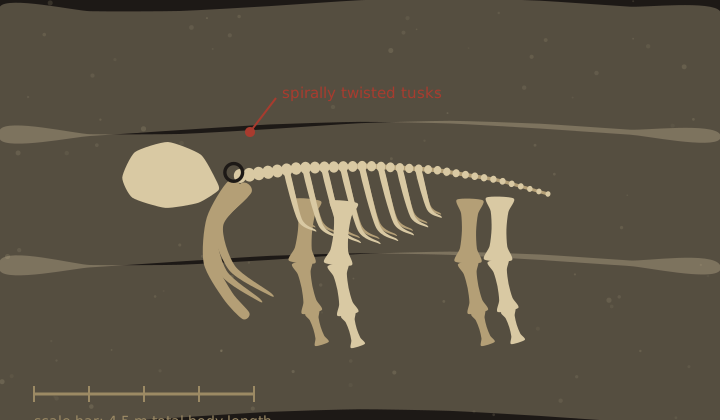
The genus, not just the woolly one
Mammuthus includes a sequence of species that can be read as a trend: increasing tooth crown height, more numerous and thinner enamel plates, and a shrinking body. The southern mammoth of the early Pleistocene was a large browser on trees; the later steppe and woolly mammoths were high-crowned grazers of open ground.
- M. meridionalis -- early Pleistocene, large, browsing.
- M. trogontherii -- steppe mammoth, taller, grazing.
- M. primigenius -- woolly mammoth, smallest, highest-crowned, Arctic.
Reading a tusk as a record
Mammoth tusks grow in layers and the stable-isotope ratios in those layers record where the animal moved and what it ate. In one well-studied Alaskan individual, the isotope series tracks a lifetime of seasonal migration and ends with a distinctive nitrogen signal interpreted as starvation in its final winter.
How a carcass survives 40,000 years
Mammoths are known from carcasses, not just bones. Permafrost in Siberia and Alaska preserves skin, hair, stomach contents and, in a few cases, blood and tissue at the cellular level. The Berezovka and Lyuba specimens are complete enough that gut contents have been identified to genus.
| Specimen | Age | What it preserved |
|---|---|---|
| Berezovka | ~44,000 yr | skin, hair, stomach contents |
| Lyuba | ~42,000 yr | near-complete calf, including internal tissues |
| Yuka | ~39,000 yr | skin, foot pads, largely intact carcass |
Three carcasses that carry information no skeleton can.
The end, by region
Mainland woolly mammoths disappear from the fossil record between about 15,000 and 12,000 years ago, with the last mainland dates in Siberia around 11,000 years ago. Populations in the Bering Strait islands held on longer, and the Wrangel Island population survived until roughly 2000 BCE. The cause shifts with latitude: habitat change in the south, pressure from people in the north and, on Wrangel, the slow cost of being few.
Sources
Reference works and further reading for the material in this entry.
Where the argument is
Why the last mainland population died out. Climate-driven habitat loss, hunting by humans, and a combination of the two have all been argued, and the answer differs by region: on Wrangel Island the population survived until about 4,000 years ago, well after mainland extinction, and recent genomic work on Wrangel specimens found a sharp loss of genetic diversity before the end.
Frequently misread
-
ClaimMammoths are the ancestors of elephants.
What the record showsThey are close cousins. Mammuthus and the living elephant genera diverged several million years ago; the Asian elephant is the mammoth's nearest living relative, but it is not descended from Mammuthus primigenius.
-
ClaimThey were killed off by a single sudden event, and we know the population was small.
What the record showsThe mainland decline took thousands of years and its timing varies across the range. Wrangel Island populations were isolated and small for millennia, which is exactly why their genomes show inbreeding -- a detail that applies to that island, not to the species as a whole.