Devonian 419 to 359 Ma
Dunkleosteus
邓氏鱼属
The largest animal of the Devonian, and a fish that had no teeth. Its jaws were armoured blades that sharpened against each other, and it shared the shallow seas of what is now Ohio with early sharks, bony fishes and the first four-limbed animals.
Published Reading time 2 min read
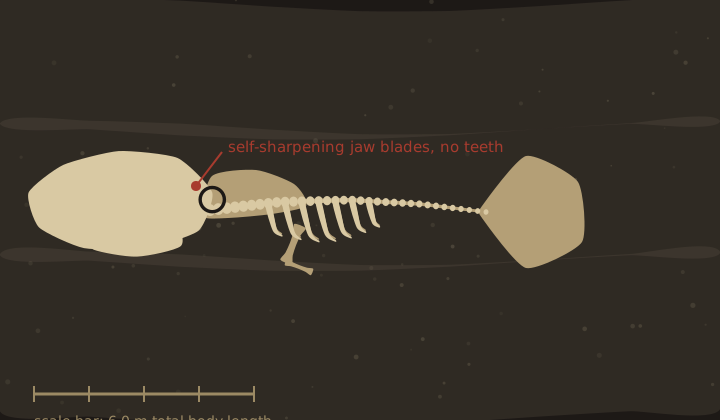
A jaw with no teeth in it
Dunkleosteus belongs to the placoderms, a group that separated from other jawed vertebrates early. Instead of teeth, placoderms have gnathal plates: extensions of the jaw bones with sharpened, often serrated edges. In Dunkleosteus the plates are large and thin, and the upper and lower sets slide past each other to shear. As the plate wears, it remains sharp.
- No enamel, no dentine, no replacement of individual teeth.
- Blades are bone that keep a sharp edge by abrasion.
- Four cutting units: two upper, two lower.
The Cleveland Shale and the famennian sea
The Cleveland Shale was deposited in a deep, anoxic basin on the southern shore of the Devonian sea that covered much of what is now Ohio. Because the bottom was anoxic, carcasses that sank into it were not scavenged, and Cleveland Shale specimens are often preserved with the head plates intact and the shark-like tail and the internal skeleton in outline. Dunkleosteus shares those beds with the shark Cladoselache.
| Animal | Size | Role |
|---|---|---|
| Dunkleosteus | ~4 m | apex predator |
| Cladoselache | up to 1.8 m | mid-level predator, agile |
| Ctenacanthus | ~2 m | benthic shark with fin spines |
| Early bony fishes | typically < 0.5 m | prey |
The Cleveland Shale community, from the larger specimens down.
How it grew, and what that says
Study of Dunkleosteus jaw plates showed that the blade edges are resorbed and rebuilt during growth, which is why plates from different-sized individuals can look quite different and why some of the species names in the literature turned out to be growth stages.
How it died out
Placoderms as a whole disappear at the end of the Devonian, in the same set of extinctions that removed the reef ecosystems and many of the world's shallow-marine groups. Dunkleosteus is the largest and last of its line rather than an ancestor of later fishes; the surviving jawed vertebrates descend from groups that were small and unobtrusive while it was alive.
Sources
Reference works and further reading for the material in this entry.
Where the argument is
How strong the bite actually was. Published estimates have ranged from about 5,000 N to over 7,000 N at the blade tips, with one widely cited paper putting it near the top of any fish measured. Later work pointed out that the high figures assumed a jaw-closing muscle mass larger than the muscle-attachment areas can support, so the numbers have come down, though the bite is still among the strongest known for a fish.
Frequently misread
-
ClaimIt had a bony, armoured head because it was primitive and clumsy.
What the record showsThe armour is thin plates over a cartilaginous skull, and biomechanical work on the shoulder joint indicates Dunkleosteus had a wider range of head and jaw movement than most fish. Armour is not the same as clumsiness.
-
ClaimIt had true teeth.
What the record showsIt has no teeth. The biting edges are self-sharpening blades of bone that grow from the jaw plates, and they meet in a shear rather than in a crush. True teeth with enamel appeared on a different branch of the vertebrate tree.