Cambrian 539 to 485 Ma
Olenoides
油栉虫属
A middle Cambrian trilobite, and one of the few known in three dimensions with its legs, antennae and gut intact. From the Burgess Shale, where mudflows buried a living seafloor community in fine-grained mud.
Published Reading time 2 min read
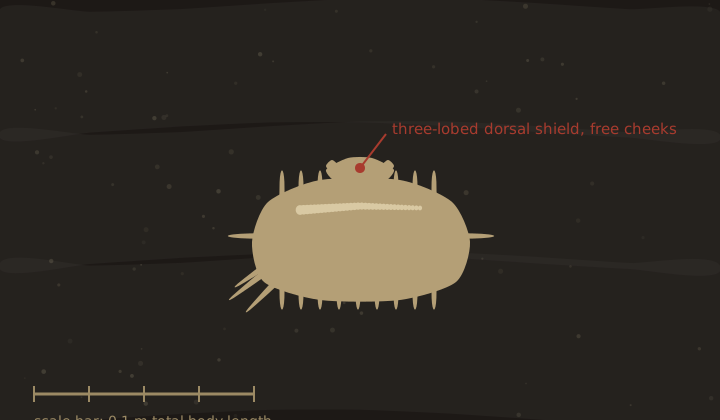
Why this trilobite is famous
Most trilobites are known from their dorsal shield alone, because that is the only mineralized part and the only part that survives ordinary fossilization. The Burgess Shale is not ordinary. Olenoides specimens from the Walcott and Marble Canyon quarries preserve the dorsal shield and, under it, the walking legs with their gill branches, the antennae in front, and a dark trace along the midline that is the gut.
- Dorsal shield: three lobes, a raised central axis and two side lobes.
- Legs: one pair per segment, each with an inner walking branch and an outer gill branch.
- Antennae: a single long pair in front of the mouth.
- Gut: a dark mid-line trace from mouth to pygidium.
Moulting, and why there are so many specimens
Trilobites grew by moulting, and the moulted exoskeleton comes apart along weak lines, with the free cheeks often separating from the cranidium. Many Burgess Shale slabs show accumulations of disarticulated shields, which are moults rather than dead animals. Distinguishing a moult assemblage from a death assemblage is one of the routine judgements in trilobite work.
The Burgess Shale, and how it was found
Charles Walcott discovered the main quarry in 1909 on Fossil Ridge in Yoho National Park, and worked it for years while he was Secretary of the Smithsonian. The Marble Canyon quarry, found in 2012 about 40 km to the southeast, produces a somewhat different community and helped show that the Burgess Shale is not one deposit but a set of them, separated in space and time.
| Quarry | Found | Character |
|---|---|---|
| Walcott Quarry | 1909 | the classic Burgess assemblage |
| Raymond Quarry | 1930 | coarser, different preservation |
| Marble Canyon | 2012 | new taxa, dense Olenoides clusters |
Three quarries, one formation, and no two giving the same animal list.
How it fed
The legs of Olenoides are grooved and the animal has no detectable jaws. The standard reading is a deposit feeder: legs churned the surface sediment, a food groove along the leg passed particles forward to the mouth, and the animal digested whatever organic matter came with them. Some specimens show the gut filled with mud.
Sources
Reference works and further reading for the material in this entry.
Where the argument is
Whether the Burgess Shale trilobites were tolerant of low oxygen. The Marble Canyon quarry has produced Olenoides in dense clusters along with evidence of mass mortality, and one reading is that these were animals killed by an oxygen-poor mudslide. A 2017 study of the distributions argued that trilobites in the Burgess Shale were not confined to well-oxygenated patches, which weakens the oxygen-tolerance argument.
Frequently misread
-
ClaimThe Burgess Shale preserves only hard parts, so soft-bodied animals there are not real.
What the record showsThe Burgess Shale is a soft-tissue deposit: the animals were buried in fine mud by mudflows, and what is preserved is largely cuticle, gut traces and limbs. That is why Olenoides is known in three dimensions with legs and antennae -- the hard, mineralized part of the exoskeleton is only part of the fossil.
-
ClaimTrilobites died out before the dinosaurs appeared.
What the record showsTrilobites appeared in the Cambrian and survived until the end-Permian extinction, 252 million years ago -- which is after the first dinosaurs had already appeared in the Triassic. They were extinct before the Jurassic, but not before the dinosaurs.