Carboniferous 359 to 299 Ma
Meganeura
巨脉蜻蜓属
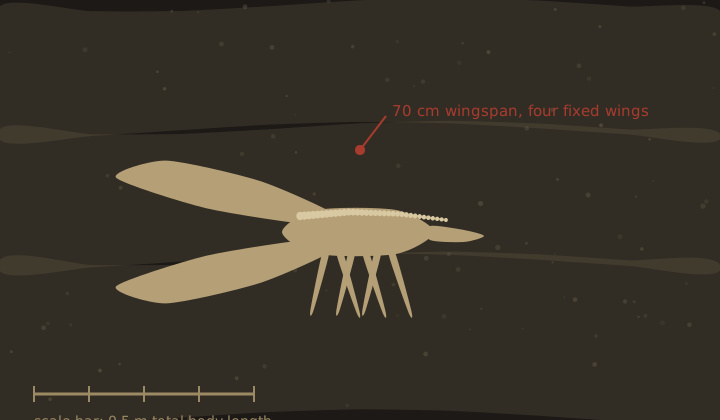
The largest flying insect of the Carboniferous, and one of the largest that ever lived: a wingspan approaching 70 cm, a body of about 30 cm, and a flight apparatus built for active pursuit above the coal-forming swamps.
Published Reading time 2 min read
The coal swamps it lived over
Meganeura comes from the Commentry basin in France and from Bolsover in England, both deposits formed in the lowland forests that produced the coal seams of the Carboniferous. Those forests grew on wet, unstable substrates in a climate with a strong seasonal dry period, and the trees -- lycopsids and tree ferns, not flowering plants -- were different from anything alive now.
- Coal measures: floodplain and delta deposits.
- Forest trees: clubmosses, horsetails, tree ferns.
- Flowering plants had not yet appeared.
Wings, counted and measured
A complete Meganeura wing is about 30-35 cm long, and the animal had four of them. The venation is preserved in fine detail in the Commentry shales, and it is dense and regular, with cross-veins forming a stiff grid. The wing base carries a structure that in living odonates is a nodus, a point at which the wing can flex; its presence in Meganeura indicates controlled twisting in flight.
| Feature | Meganeura | Living dragonfly |
|---|---|---|
| Wingspan | up to ~70 cm | typically 5-12 cm |
| Wings | 4, independently controlled | 4, independently controlled |
| Flight | powered, capable of hovering | powered, capable of hovering |
| Breathing | tracheae | tracheae |
Same design, three times the linear scale.
The oxygen argument, examined
Carboniferous atmospheric oxygen is estimated from charcoal and from the isotope composition of fossil plant material at around 30-35 percent, against 21 percent today. Higher oxygen partial pressure lets a diffusion-based respiratory system supply a larger body. The pattern across the Carboniferous -- several groups of arthropods reach their maximum size, then shrink as oxygen falls in the Permian -- fits the model reasonably well, though the size of the effect on any one species is debated.
What it ate
Meganeura had large compound eyes and legs covered in spines that close like a basket, which is how an odonate holds prey. Carboniferous forests also contained the giant arthropleurids and a wide range of smaller insects, and a large flying predator would have been able to take them on the wing. Meganeura's own predators would have been the largest of the contemporary amphibians and reptiles.
Sources
Reference works and further reading for the material in this entry.
Where the argument is
Why insects were so large in the Carboniferous. The classic explanation is hyperoxia: atmospheric oxygen reached around 35 percent, and because insects breathe through tracheae that deliver oxygen by diffusion, higher oxygen allows larger bodies. The counter-argument is that the largest Meganeura is only about 25 percent bigger than the largest living damselfly, which is a modest difference, and that oxygen availability would not by itself explain a giant unless the animal's flight was also oxygen-limited.
Frequently misread
-
ClaimMeganeura was a dragonfly.
What the record showsIt is a member of Odonatoptera, the stem group that includes dragonflies and damselflies, and it sits outside the crown group. It is closer to the origin of the lineage than any living dragonfly, so calling it a dragonfly is convenient but not accurate.
-
ClaimIt could not fly well and glided only.
What the record showsThe wing structure is that of an active flier: a dense, regular venation network with a stiff leading edge and independent control of each of the four wings. That is the same configuration that lets a living dragonfly hover and reverse direction.