Triassic 252 to 201 Ma
Plateosaurus
板龙属
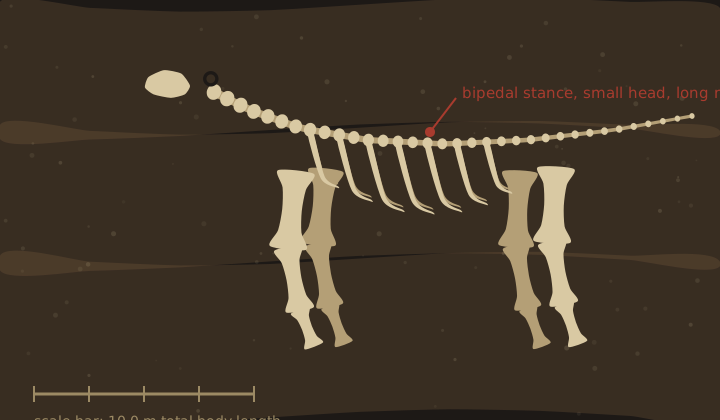
The best-known Triassic dinosaur and one of the most abundant, with well over a hundred skeletons recovered from a single quarry at Trossingen in Germany. A large, long-necked animal that walked on two legs and could not put its hands flat on the ground.
Published Reading time 2 min read
The Trossingen quarry
Three major excavations at Trossingen between 1911 and 1932 recovered between 30 and 50 articulated skeletons from the first diggings and dozens more from the later ones, in a bone bed about 1.5 m thick. The animals are jumbled but most are complete, and nearly every individual sits in the same orientation, which suggests they were aligned by flowing water before burial.
- Bone bed thickness: about 1.5 m.
- Specimens: well over 100 across the three digs.
- Sediment: muddy floodplain deposits.
The hand that could not go flat
This is the detail that decides the posture argument. In Plateosaurus, the radius and ulna cannot rotate over each other enough to turn the palm to the ground; the joint is built to keep the hand in a grasping, opposing orientation. An animal with such a wrist cannot take its weight on its hands, so it walked on its hind limbs, and any quadrupedal posture could only have been a brief prop while feeding or fighting.
| Element | Plateosaurus | A true quadruped (Triceratops) |
|---|---|---|
| Forelimb vs. hindlimb | forelimb much shorter | forelimb about as long |
| Wrist rotation | cannot pronate the hand | fully pronated, weight-bearing |
| Habitual gait | bipedal | quadrupedal |
The one joint that decides whether an animal can walk on four legs.
What it ate
The teeth are coarsely serrated and leaf-shaped, suited to coarse plant material, and the jaw carries a small downward-projecting crest at the front of the dentary. Stomach contents from one specimen have been reported as containing plant material and small bones. Plateosaurus is generally treated as herbivorous with some opportunistic feeding, and the wide size range of adults at the same site is best explained by growth rather than by two species.
Size and growth
Adult Plateosaurus vary enormously in size, from about 5 to 10 m, at the same localities and in the same beds. Histological work found the variation is largely a matter of how much the animals grew, and that they kept growing well into adulthood, with the largest individuals being the oldest. The genus is a good illustration of how much an animal can grow after it reaches sexual maturity.
Sources
Reference works and further reading for the material in this entry.
Where the argument is
Whether Plateosaurus was bipedal or quadrupedal. The arms are shorter than the legs and the hand cannot be pronated flat to the ground, which makes a normal quadrupedal stance impossible. The current reading is that it walked on two legs and could rear up and lean on its hands for feeding or display. This is the same argument that runs through the sauropodomorphs as a whole.
Frequently misread
-
ClaimPlateosaurus was a slow, heavy quadrupedal ancestor of the sauropods.
What the record showsIt is an early sauropodomorph and it could not walk on four legs, because the wrist joint does not permit the hand to lie flat. It was bipedal, and it was not a direct ancestor of the sauropods but a branch off the same stem.
-
ClaimThe hundreds of skeletons found together mean it lived in herds.
What the record showsBone-bed accumulations can be produced by a flood concentrating scattered carcasses, which is the standard reading for the German Plateosaurus beds: the sediments are muddy floodplain deposits and the animals are size-sorted. Whether they were social is not established by their being buried together.