Triassic 252 to 201 Ma
Coelophysis
腔骨龙属
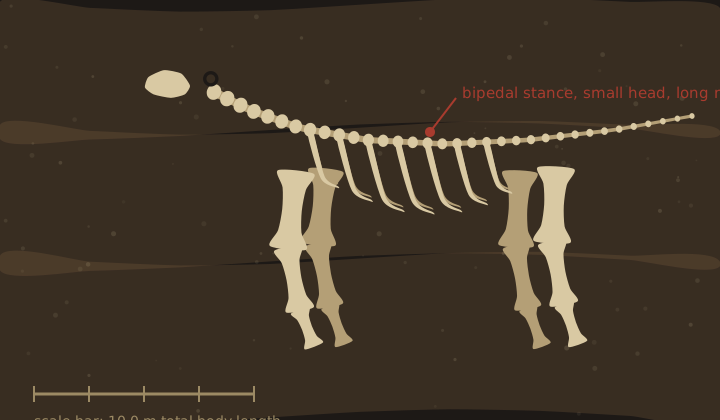
A slender Triassic predator from New Mexico, and the dinosaur known from the largest number of individuals of any Triassic genus. The 1947 Ghost Ranch quarry produced hundreds of skeletons in a single bed, which makes it the anchor for early dinosaur anatomy.
Published Reading time 2 min read
The Ghost Ranch quarry
The quarry in the Chinle Formation was found by Edwin Colbert and George Gaylord Simpson's team in 1947 and worked for several seasons. It has yielded well over a thousand specimens of Coelophysis, mostly disarticulated, packed into a single mudstone layer along with the phytosaur Rutiodon and other reptiles. The accumulation appears to be a flood deposit that concentrated animals from a wider area.
- Specimens recovered: over 1,000.
- Mostly disarticulated and mixed.
- The site is a New Mexico state repository; collecting is not permitted.
A body built for speed on land
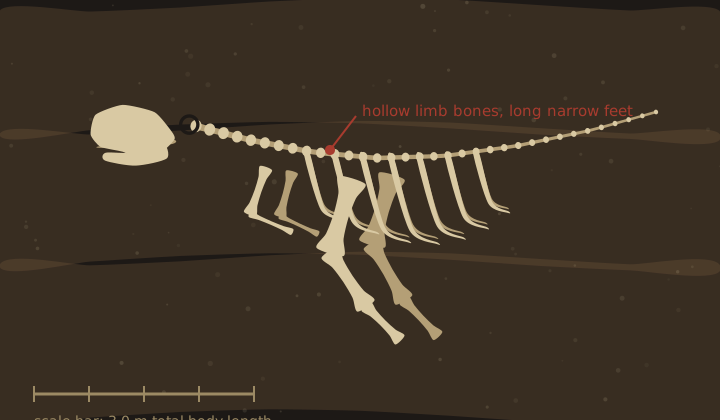
The limb bones are hollow -- which is what the name means -- and thin-walled, the hind limbs are long relative to the trunk, and the tail is long and flexible. The hand has three functional fingers with the fourth and fifth reduced to nubs. Trackways attributed to coelophysids show long strides and a narrow gauge.
| Feature | Coelophysis | A late theropod (Tyrannosaurus) |
|---|---|---|
| Limb bone walls | thin, hollow | thick, marrow-filled |
| Hand | 3 functional fingers + 2 nubs | 2 fingers |
| Body size | ~25 kg | ~6,000-8,000 kg |
| Age | Late Triassic | Late Cretaceous |
Same lineage, 150 million years and a full redesign apart.
Growth and the juveniles
The quarry's sample includes animals from very small to adult size, and study of the limb bone histology showed that a large share of them were not fully grown. If most of the assemblage is subadult, then the site records a mass death of a growing cohort rather than of an adult population.
Where it sits in Triassic time
Coelophysis lived in the Late Triassic, roughly 215 million years ago, at a time when dinosaurs were still a minority of the terrestrial fauna. In the Chinle beds, dinosaurs are less common than the phytosaurs and the aetosaurs. The pattern of dinosaurs increasing in abundance only in the Jurassic is one of the standard observations of the period.
Sources
Reference works and further reading for the material in this entry.
- National Park Service
- International Commission on Stratigraphy
- Paleontological Research Institution
- Geological Society of America
Where the argument is
Whether Coelophysis ate its own young. The 1947 Ghost Ranch quarry produced hundreds of skeletons, and the Smithsonian mount of 1989 included one small skeleton apparently inside the ribcage of a larger one. A 2006 re-examination of the specimen found the small skeleton was actually a small crocodilian-like reptile, not a juvenile Coelophysis, and the cannibalism claim lost its main evidence.
Frequently misread
-
ClaimCoelophysis was a cannibal, as shown in the museum mount.
What the record showsThe specimen behind the claim was re-identified in 2006 as a different animal. Some Ghost Ranch specimens do contain small bones in the gut, but they belong to other taxa -- and there is evidence of a fish-eating individual among them.
-
ClaimCoelophysis had a wishbone and was nearly a bird.
What the record showsA furcula has been reported in Coelophysis, and if the identification is correct it pushes the origin of the wishbone back before the theropods. It does not make Coelophysis bird-like; the animal is a very early theropod with a typical Triassic body plan.