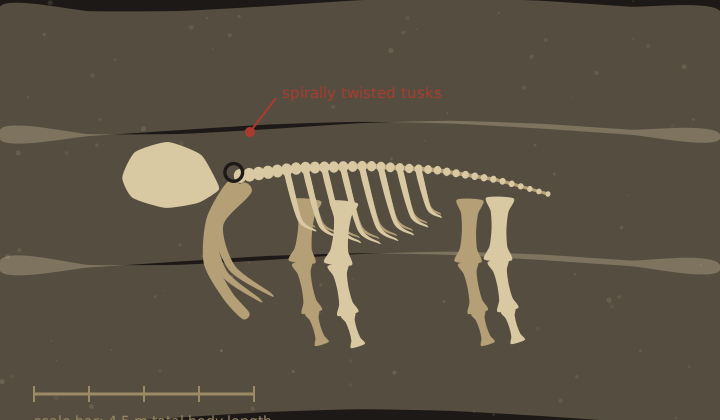
Quaternary 2.6 to 0.0 Ma
Smilodon
斯剑虎属
The best-known sabre-toothed cat, and the animal whose remains fill the Rancho La Brea tar pits in Los Angeles. Over 2,000 individuals have been recovered there, which makes it one of the best-sampled extinct mammals anywhere.
Published Reading time 2 min read
The tar pits, and what they record
Rancho La Brea is a set of asphalt seeps that have been active for tens of thousands of years. Animals that stepped into the sticky asphalt were trapped, and predators that came to feed on them were trapped in turn. That is why the deposit is dominated by carnivores rather than herbivores -- the reverse of a normal fossil assemblage -- and why Smilodon is the most common large mammal in it.
| Species | Individuals recovered | Note |
|---|---|---|
| Smilodon fatalis | over 2,000 | the most common large mammal |
| Canis dirus | over 3,000 | the dire wolf |
| Panthera atrox | about 80 | the American lion |
| Bison antiquus | several hundred | the most common herbivore |
What the tar pits contain, and why the carnivores outnumber the herbivores.
A body built for a specific way of killing
Smilodon has a heavy skull, powerful forelimbs and a wide gape of about 120 degrees. The canines are long, thin in cross-section and serrated on both edges, and the jaw-closing muscles are reduced relative to a modern lion's while the neck and forelimb muscles are enlarged. The whole configuration -- a cat that can pin an animal down with its forelimbs and then apply a controlled, deep bite -- matches the model of a predator of large, slow prey.
- Gape: about 120 degrees, far wider than a lion's.
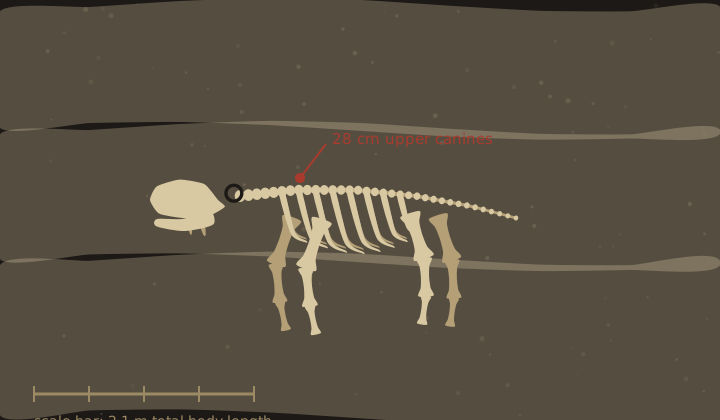
- Canines: up to 28 cm including the root, thin and serrated.
- Forelimbs: robust, for grappling.
- Tail: very short.
What it ate, and evidence of how
Isotope work on Rancho La Brea Smilodon bones gives a diet dominated by bison and camels, with some horses. Bite marks on the bones of prey and healed injuries on Smilodon specimens -- including broken canines that had worn smooth, showing the animal lived on after the break -- are the direct evidence, and the frequency of broken canines is high.
Extinction
Smilodon disappeared from North America around 10,000 years ago (per Florida Museum of Natural History), at the end of the Pleistocene, along with most of the large mammals of the continent. Its reliance on large prey, and the loss of that prey at the same time, is the standard explanation; direct human hunting of Smilodon itself is not required for the decline.
- Last appearance in North America: about 10,000 years ago.
- S. populator survived longer in South America, to around 10,000 years ago as well.
- Loss of large herbivores is the leading explanation.
Sources
Reference works and further reading for the material in this entry.
Where the argument is
How the sabres were used. The two standing models are a deep, shearing bite to the throat, and a weaker bite used to hold while the prey bled out. The fragility of the canines -- they break, and broken ones are common in the fossil record -- supports the second, and a 2007 study of bite mechanics concluded Smilodon could not have bitten into bone without risking its teeth.
Frequently misread
-
ClaimSmilodon is the sabre-toothed tiger.
What the record showsIt is not a tiger and not close to one. Smilodon belongs to the subfamily Machairodontinae, which separated from the line leading to living cats long before tigers existed. Its build -- short limbs, heavy body, almost no tail -- is unlike any living cat.
-
ClaimIt was a fast runner that chased down prey.
What the record showsThe hind limbs are short and the body is heavy, which is a build for short bursts and for wrestling large prey to the ground. The lumbar region is also comparatively stiff. It is closer in proportion to a bear than to a cheetah.