Paleogene 66.0 to 23.0 Ma
Basilosaurus
龙王鲸属
An early whale from the Eocene, up to 20 metres long and shaped like a snake, with tiny hind limbs still attached to a body that had already left the land. Its skeletons are the reason part of the Egyptian desert is called the Valley of the Whales.
Published Reading time 2 min read
A whale that still looks like an animal
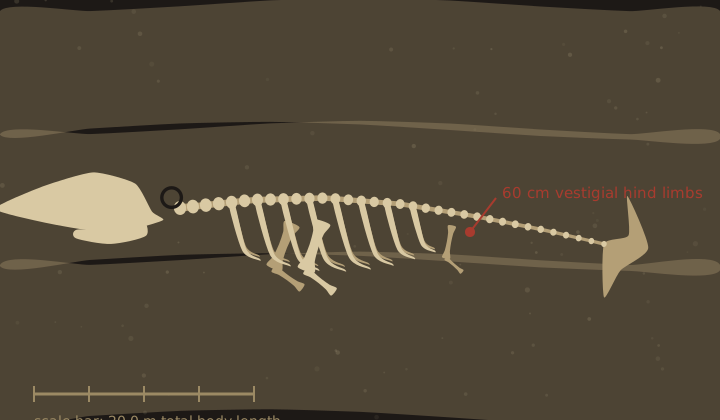
Basilosaurus has a long, flexible body and an undulatory spine, unlike a modern whale's rigid torso. The nostrils are on top of the head but set partway back, not yet at the blowhole position of a modern cetacean. There is a tail fluke, but it is small relative to the body. The whole animal records a stage of the transition to fully marine life that was nearly complete but not quite finished.
- Nostrils: on top of the head, partially retracted.
- Hind limbs: about 60 cm, not connected to the spine.
- Pelvis: present but reduced.
- Teeth: two-rooted cheek teeth, unlike modern whales.
Wadi El Hitan
The Valley of the Whales in the Fayum region of Egypt is a desert basin containing the remains of hundreds of Basilosaurus and of the smaller Dorudon, along with sea turtles, crocodiles, sharks and mangroves. The site is a UNESCO World Heritage property, listed in 2005, and it is the reason Eocene whale evolution is mostly read from Egyptian material.
| Whale | Length | Role at the site |
|---|---|---|
| Basilosaurus isis | up to 20 m | the largest predator present |
| Dorudon atrox | about 5 m | abundant; juveniles show bite marks |
| Other vertebrates | -- | turtles, crocodiles, sharks, fish |
Two whales dominate the Fayum beds, and one of them has been bitten by the other.
What it ate
Stomach contents of Basilosaurus have been reported containing fish bones, shark teeth and smaller whales. A skull of the juvenile Dorudon with puncture marks matching Basilosaurus teeth has been described, which is direct evidence of predation on other cetaceans. Basilosaurus was the largest predator in its ecosystem.
How it grew and where it lived
Basilosaurus was fully marine: no specimen has been found with limbs capable of supporting it on land, and its distribution runs from Egypt to the Gulf Coast of the United States and to Peru. Studies of the isotope composition of its teeth found it fed in surface waters, unlike some later whales that specialize at depth, and its bones are dense in the way of an animal that swam constantly.
Sources
Reference works and further reading for the material in this entry.
Where the argument is
How much tail fluke it had. The vertebral column is undulatory and the animal is long and flexible, which for a fully pelagic whale is unusual. A well-preserved specimen from Wadi El Hitan preserves the tail, and the fluke is present but small, which supports the reading that Basilosaurus swam with the whole body rather than with the tail alone.
Frequently misread
-
ClaimBasilosaurus was a sea serpent or a reptile.
What the record showsHarlan named it as a reptile in 1834, which is where the '-saurus' comes from. Owen diagnosed it as a mammal five years later on the basis of the teeth and the skull. It is a whale -- an early one -- and its name is a fossil of the original mistake.
-
ClaimIt had hind legs because it was a whale that could still walk.
What the record showsThe hind limbs are present but tiny -- about 60 cm in a 15 m animal -- and they are not attached to the vertebral column. They could not have borne the animal's weight or helped it walk. They are vestigial limbs, and their function, if any, is unknown.