Cambrian 539 to 485 Ma
Hallucigenia
怪诞虫属
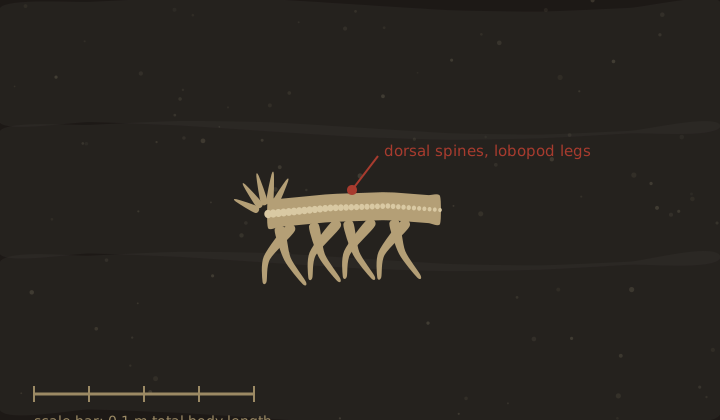
A 3 cm Cambrian lobopodian that was reconstructed upside down for fourteen years, and whose name records the confusion. From the Burgess Shale and Chengjiang, with spines, lobopod legs and a head at what everyone had assumed was the tail.
Published Reading time 2 min read
The reconstruction that went wrong
Conway Morris named the genus in 1977 from Burgess Shale material. The specimens are flattened, and the most conspicuous features are a set of long spines and a set of slender tubes. He read the spines as legs and the tubes as feeding tentacles, and reconstructed the animal standing on its spines, in the position that gave it its name. The animal is bilaterally symmetrical and had a clear top and bottom; the reading was simply inverted.
| Year | Reconstruction | Basis |
|---|---|---|
| 1977 | on its spines, tentacles above | flattened Burgess material |
| 1991 | lobopod legs below, spines above | Chengjiang material |
| 2015 | head identified, with eyes and mouth | electron microscopy of the head region |
Thirty-eight years to put one small animal the right way up.
The claws, and what they settle
The lobopod legs of Hallucigenia end in a single curved claw, and the claws are stacked in a nested series like the claws of a living velvet worm. That detail is what puts the genus in the lobopodians and identifies it as close to the origin of the velvet worms. The velvet worms today are terrestrial predators with the same lobopod legs and the same claw structure.
The spines, and what they are for
The dorsal spines are long, curved and pointed, and in some specimens they are preserved with a socket at the base. They are too thin to have carried the animal's weight and too rigid to have been sensory. The obvious reading is defense, and the Cambrian seafloor where Hallucigenia lived also contained Anomalocaris, a predator large enough to swallow it whole.
What it ate
The gut of Hallucigenia has been examined and found to contain spicules -- the mineralized skeletal elements of sponges. That is a specific identification, not just 'organic matter', and it makes Hallucigenia a sponge feeder, using its small mouth to draw in fragments of sponge tissue.
- Gut contents: sponge spicules.
- Mouth: small, terminal, in the head.
- No jaws and no teeth.
Sources
Reference works and further reading for the material in this entry.
Where the argument is
Which way up it went, and which end was the front. Conway Morris reconstructed Hallucigenia in 1977 standing on its spines with a row of tentacles on top, which produced the name and thirty years of confusion. In 1991 Lars Ramskold and Hou Xian-guang, working from better Chengjiang material, showed the spines were dorsal and the lobopod legs were ventral, and that the 'head' was at the other end.
Frequently misread
-
ClaimIt walked on its spines and had tentacles on its back.
What the record showsThat was the 1977 reconstruction, made from flattened Burgess material before better specimens were available. The spines are dorsal, they are defensive and stiff, and the legs are the lobopods. The animal is upside down in the classic illustration.
-
ClaimThe 'head' blob is a head.
What the record showsThe blob at the end of the body was interpreted as a head for decades. Re-examination with electron microscopy found paired eyes and a mouth in a different, smaller region, and that the blob was a stain from decayed tissue.