Cretaceous 145 to 66.0 Ma
Ankylosaurus
甲龙属
The largest ankylosaur and the last, from the final two million years of the Cretaceous. Everything about it is low, wide and heavy: a broad beak, a body sheathed in bone, and a tail ending in a club of fused osteoderms.
Published Reading time 1 min read
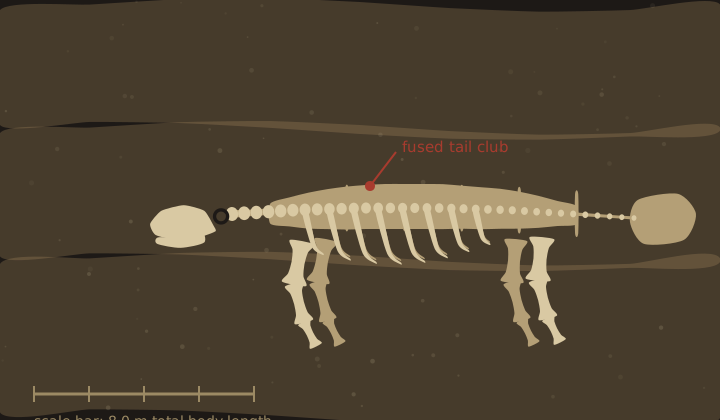
Armour, band by band
Ankylosaurus carries osteoderms in transverse bands across the neck (cervical half-rings), over the shoulders, across the back and over the hips, with smaller scutes filling the gaps and scattered along the flanks. Unlike the nodosaurids, it has a tail club and a wide, flattened skull with the horns reduced to small corner scutes.
The club, mechanically
The last few caudal vertebrae are fused into a rigid handle, and the osteoderms over them are fused into a single mass. Modelling suggests a swing could deliver several thousand newtons at the point of contact, enough to fracture bone. The same modelling found the tail could not be raised far, so the usable strike zones were low and lateral.
- Club mass in the largest individuals: on the order of 50-100 kg.
- Fused handle: the last 3-4 caudal vertebrae.
- Strike zone: lateral, at or below hip height.
Why we know so little about the body
No complete Ankylosaurus skeleton has been collected. The description rests on a partial skeleton, a few skulls, and isolated osteoderms. Body length is extrapolated from better-known relatives, which is why published mass estimates for the genus spread across a factor of nearly two.
Living at the end
Ankylosaurus shares the Hell Creek beds with Tyrannosaurus and Triceratops, and its scutes are among the most commonly found vertebrate fossils there because they survive weathering better than any other bone in the formation. The genus disappears at the Cretaceous-Paleogene boundary with the rest of the non-avian dinosaurs.
Sources
Reference works and further reading for the material in this entry.
Where the argument is
Whether the tail club was swung at predators or used in within-species combat. Finite-element modelling of club impact published in 2009 found the club could generate enough force to break bone but that the tail's range of motion was limited, favouring side-to-side swings at low targets such as legs rather than a raised, overhead blow.
Frequently misread
-
ClaimIts back was covered in a solid turtle-like shell.
What the record showsThe armour was made of individual osteoderms set in the skin, in bands across the neck, back and flanks, with rows of keeled scutes. The bands allowed the animal to flex; a solid shell would not.
-
ClaimThe club was a single lump of bone.
What the record showsIt was built from several enlarged osteoderms fused to the last few caudal vertebrae, and the vertebrae inside it are still visible on good specimens. The handle -- the flexible part of the tail in front of the club -- is where the leverage came from.