Cretaceous 145 to 66.0 Ma
Triceratops
三角龙属
The most abundant large herbivore in the Hell Creek Formation, and the dinosaur whose skull is easiest to identify from a single fragment. Skulls reach 2 metres, a quarter of which is frill.
Published Reading time 1 min read
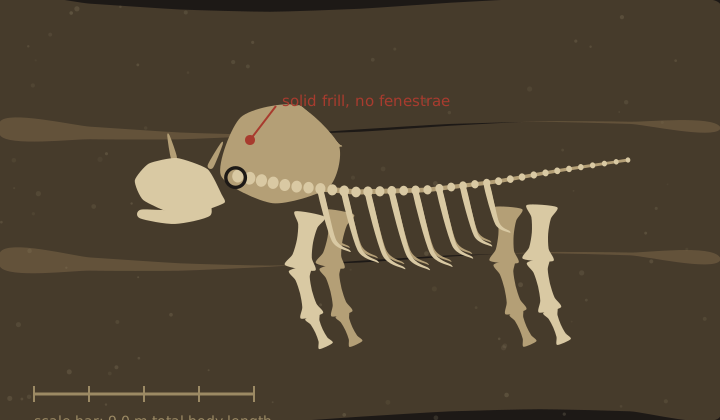
A skull built from fused plates
The frill is the parietal and squamosal bones extended backwards and locked together. In Triceratops it is solid, with no openings, which is unusual among ceratopsids and makes the skull heavy. The beak is a single bone at the front of the lower jaw, and the teeth sit in a shearing battery that replaced worn teeth continuously.
What it ate, and how we know
The lower jaw describes a near-vertical shear, and microwear on the teeth is dominated by fine parallel scratches rather than pits. That combination fits shearing tough, fibrous plants close to the ground -- ferns, cycads and early flowering shrubs -- rather than grazing abrasive grass, which had not yet spread.
- Beak: cropping, not chewing.
- Dental battery: up to 36 tooth positions per side, stacked.
- Microwear: fine parallel striations, few pits.
Horn growth over a lifetime
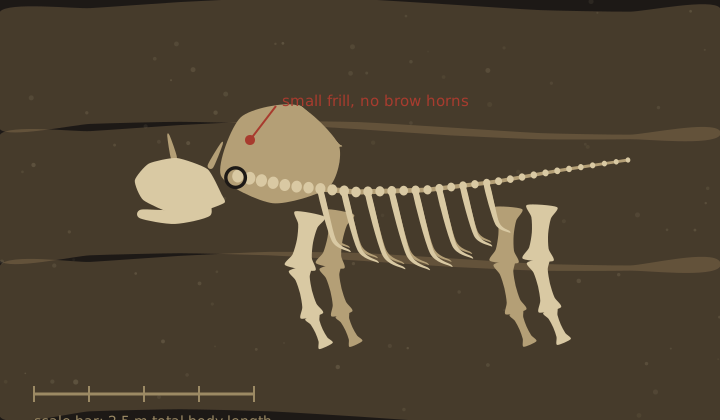
Juveniles have short, straight brow horns that point upward, and the frill is proportionally small. Study of horn cross-sections shows they grew continuously and were probably covered in keratin, so their true length in life was longer than the bone core.
Evidence of what attacked it
Triceratops specimens carry a notable range of healed and unhealed injuries: punctures matching tyrannosaur teeth on frills and on the squamosal, bite marks on a horn, and one specimen with a partial tyrannosaur tooth embedded in a vertebra. There is also a documented infection around a broken horn, which suggests the horns were used in contact.
| Injury type | Element | Reading |
|---|---|---|
| Puncture | frill / squamosal | tyrannosaur-sized tooth spacing |
| Healed fracture | brow horn | contact between individuals |
| Embedded tooth | vertebra | survived at least one attack |
The three injury patterns most often cited from Hell Creek material.
Sources
Reference works and further reading for the material in this entry.
Where the argument is
What the frill is for. Sexual display, species recognition and thermoregulation have all been proposed. A 2022 review of frill blood-vessel traces found no convincing evidence of a heat-exchange role, which leaves display and species recognition as the surviving explanations rather than the proven ones.
Frequently misread
-
ClaimThe three horns point forward like a bull's.
What the record showsThe brow horns sit above the eyes and curve forward and slightly outward; the third horn is a short, stout nasal horn. The frill, not the horns, is what dominates the skull from above.
-
ClaimIt is the ancestor of the rhinoceros.
What the record showsTriceratops is an ornithischian dinosaur that died out 66 million years ago. Rhinoceroses are perissodactyl mammals with no dinosaur ancestry; the resemblance is convergence on the same low-browsing body plan.