Cretaceous 145 to 66.0 Ma
Protoceratops
原角龙属
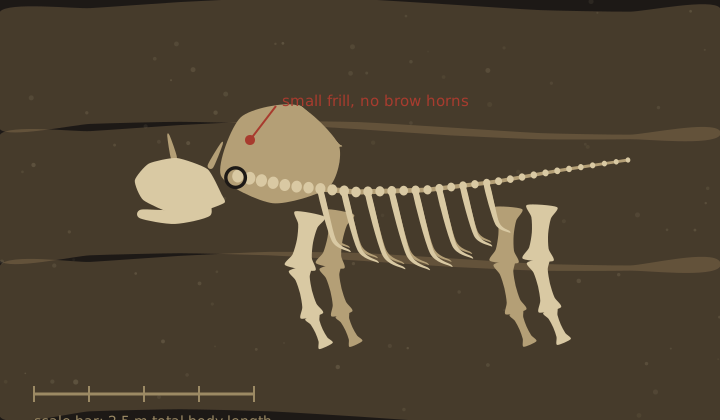
A sheep-sized ceratopsian from the Gobi, known from hundreds of specimens including nests, eggs and embryos. It is the animal in the Fighting Dinosaurs specimen, and it was the first dinosaur whose eggs were recognized.
Published Reading time 2 min read
The nest that was misidentified
The 1923 American Museum of Natural History expedition to Bayn Dzak found a clutch of elongated eggs, and near them the remains of a small ceratopsian. The animal was named Protoceratops andrewsi, and a 1924 specimen found lying over a clutch produced the name Oviraptor philoceratops -- 'egg thief, lover of ceratopsians'. In 1993 Mark Norell's team opened an egg from a Mongolian clutch and found an Oviraptor embryo. The 'thief' was sitting on its own nest.
| Year | Event |
|---|---|
| 1923 | first clutch found at Bayn Dzak; assigned to Protoceratops |
| 1924 | Oviraptor named from the animal found with a clutch |
| 1993 | an embryo inside one of those eggs identified as Oviraptor |
| 1990s | Protoceratops nests with embryos found at Ukhaa Tolgod |
Seventy years from the mistake to the correction.
The Fighting Dinosaurs specimen
The block found at Tugrikin Shireh in 1971 preserves a Protoceratops locked with a Velociraptor: the predator's sickle claw is in the region of the Protoceratops' throat, and the Protoceratops' beak is closed on one of the predator's forelimbs. It is the single most cited piece of evidence that Protoceratops was attacked by dromaeosaurs, and it also preserves the only known specimen of a Protoceratops with a complete articulated forelimb folded under the body.
Nests and growth
Nests from Ukhaa Tolgod contain up to a dozen eggs arranged in a ring, with the eggs partly buried in sediment. The hatchlings are small and have a proportionally short frill. A growth series from the Djadokhta beds shows the frill lengthens, the nasal bump enlarges and the snout deepens with age, and that the full set of adult features are not present in animals below a certain size.
- Clutch size: up to about 12 eggs.
- Egg shape: elongate, not round.
- Hatchlings: short frill, no nasal bump.
What it ate, and what ate it
The dental battery and the powerful beak indicate shearing of tough vegetation, and the animal's low head and short limbs put it at ground level. Its predators included Velociraptor, and the Djadokhta beds also yield the much larger theropod Tarbosaurus.
Sources
Reference works and further reading for the material in this entry.
Where the argument is
How the frill varied between the sexes and between ages. Specimens from Bayn Dzak differ in the size of the frill and in the presence of nasal bumps, and the standard reading is that these are males, females and juveniles of one species. The alternative is that more than one species is present. Measurements of the frill's shape found the variation is continuous, which supports the single-species reading.
Frequently misread
-
ClaimThe first fossil eggs known to science were dinosaur eggs.
What the record showsIn 1923 the American Museum expedition found eggs at Bayn Dzak and named them Protoceratops andrewsi, and the species became famous as the 'egg thief' when it was found with a clutch -- until 1993, when the embryo inside one of those clutches was identified as Oviraptor, not Protoceratops. The eggs were the predator's, not the victim's.
-
ClaimProtoceratops is the ancestor of Triceratops.
What the record showsIt is a ceratopsian at an early grade, and it lived tens of millions of years after the split that separates its family from the line leading to the large ceratopsids. It shows what an early ceratopsian looked like; it is not the ancestor of the later ones.