Cretaceous 145 to 66.0 Ma
Velociraptor
伶盗龙属
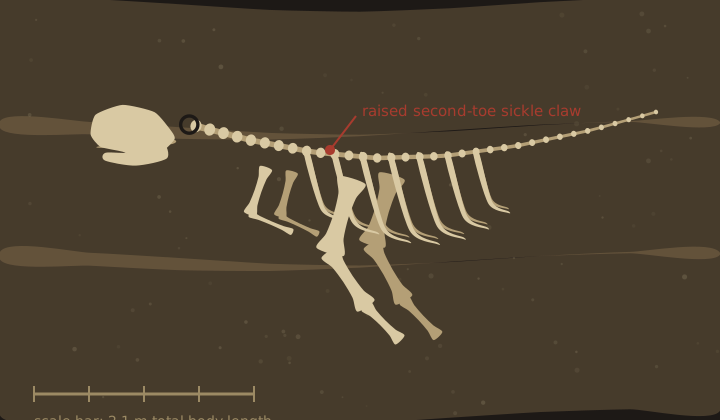
A small dromaeosaur from the Late Cretaceous of the Gobi, known from more than a dozen skeletons and one of the most informative fossil specimens ever collected: a Velociraptor and a Protoceratops locked together, both preserved in the act.
Published Reading time 1 min read
The Fighting Dinosaurs specimen
Found in 1971 at Tugrikin Shireh, the block preserves a Velociraptor with its right sickle claw embedded in the throat region of a Protoceratops, and the Protoceratops with the Velociraptor's arm in its beak. Both were buried by a sand collapse while still interacting. It is the single best evidence that dromaeosaurs attacked animals larger than themselves.
Feathers, on a dinosaur with no wishbone problem
The forearm of the Flaming Cliffs specimen IGM 100/981 carries eleven quill knobs, the bony bumps where large feathers anchor. Their presence in a flightless animal shows that pennaceous feathers preceded flight, and that at least some dromaeosaurs had a wing-like forelimb display structure.
A skull built for small prey
The snout is long and low, the jaws are slender, and the teeth are strongly recurved with fine serrations. The jaw is not built to resist the twisting loads of bringing down large prey; combined with the narrow skull, the feeding apparatus is that of an animal taking small, struggling targets.
- Skull length about 25 cm.
- Serration density on the rear teeth: 18-20 per 5 mm.
- Bite force an order of magnitude below a same-sized tyrannosaurid.
What it ate besides Protoceratops
Stomach contents have been reported from several specimens: a small pterosaur bone, fragments of a mammal, and fish scales. That range argues against a specialist and toward an opportunistic predator of whatever an animal of 15 kg could catch and swallow.
Sources
Reference works and further reading for the material in this entry.
Where the argument is
How the sickle claw was used. The 2011 'Raptor Prey Restraint' model argues the claw was a climbing and gripping tool for holding onto prey rather than a slashing blade. Direct evidence is thin either way, but the claw's cross-section is closer to a climbing spur than to a cutting edge.
Frequently misread
-
ClaimVelociraptor was human-sized and scaly.
What the record showsIt was about 1.8 metres including the tail and stood knee-high, weighing 15-20 kg. The Flaming Cliffs specimen preserves quill knobs on the forearm, which are attachment points for large feathers.
-
ClaimIt was the smartest dinosaur, smarter than a chimpanzee.
What the record showsIts brain-to-body ratio is high for a non-avian dinosaur but the absolute brain volume is small, on the order of a bird of similar mass. The chimpanzee comparison has no measurement behind it.
-
ClaimIt hunted in coordinated packs like wolves.
What the record showsThe pack-hunting case rests largely on a bone bed of the related Deinonychus and on trackway evidence, not on Velociraptor itself. No Velociraptor bone bed showing multiple adults at one kill site has been described.