Cretaceous 145 to 66.0 Ma
Deinonychus
恐爪龙属
The animal that restarted the argument about birds. John Ostrom's 1969 description of its skeleton, and his subsequent comparison with Archaeopteryx, led directly to the modern consensus that birds are living dinosaurs. It also made 'bird-like' the default expectation for theropods.
Published Reading time 2 min read
The 1964 discovery and what it changed
Ostrom found the first specimens in the Cloverly Formation of southern Montana in 1964. When he prepared the skeleton he noted a wrist joint that allowed the hand to fold sideways, a long, lightly built skull, and a furcula-like structure -- all features he recognized from Archaeopteryx, in a dinosaur that clearly could not fly. The paper he published in 1969 pulled Archaeopteryx out of its isolation as an odd bird and placed it on a dinosaurian grade.
The foot, mechanically
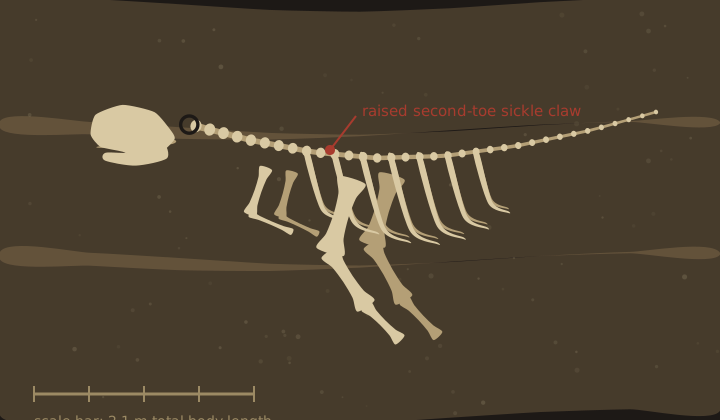
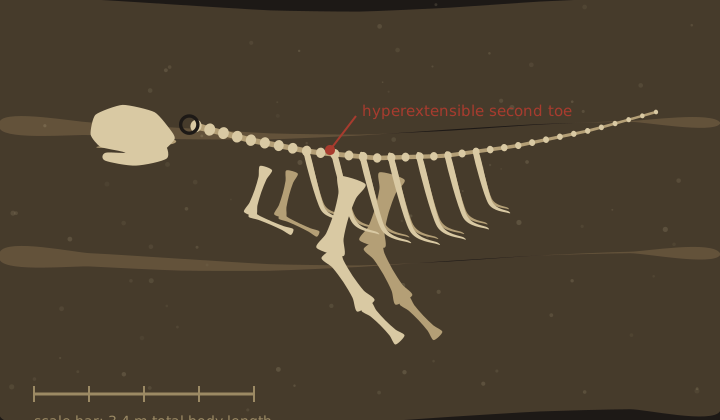
The second toe carries a claw about 12 cm long along the curve. When the animal walked, the toe was held up off the ground, so the foot's print in a trackway is two-toed -- a signature that makes dromaeosaur tracks recognizable. The joint at the base of the claw permits a wide arc of rotation, which is why the term 'hyperextensible' is used.
- Walking foot: two-toed print.
- Strike foot: second toe rotates down and forward.
- Claw shape: laterally compressed, curved, grooved -- a hook.
The bone beds and the Tenontosaurus question
At least five Cloverly localities have produced multiple Deinonychus individuals in association with a single Tenontosaurus. Tenontosaurus adults were several times the mass of a single Deinonychus. Tenontosaurus bones from these sites carry Deinonychus tooth marks, and one Tenontosaurus specimen has shed Deinonychus teeth beside it.
| Reading | Supports it | Against it |
|---|---|---|
| Cooperative hunting | adult prey far too large for one predator | bones could have accumulated later |
| Scavenging | no evidence of a kill site structure | tooth marks on many bones, not just limbs |
| Predator trap | juvenile Deinonychus also present | would need a trap at five separate sites |
The three readings of the Cloverly associations, and the objection to each.
Why it matters for birds
Ostrom's argument was not that Deinonychus was a bird, but that the features thought unique to Archaeopteryx -- the folding wrist, the wishbone, the lightly built skull, the long arms -- were present in an unequivocally non-flying theropod. If Archaeopteryx's 'bird characters' were also dinosaur characters, then classifying Archaeopteryx as a bird while excluding Deinonychus was arbitrary. That is the argument that eventually carried.
Sources
Reference works and further reading for the material in this entry.
Where the argument is
Whether the Cloverly sites show pack hunting. Multiple Deinonychus individuals are found with single Tenontosaurus carcasses at several localities, which some read as cooperative hunting of prey far larger than one Deinonychus. The alternative is a scavenging assemblage or a predator trap. Neither the bone beds nor the tooth-mark distribution settles it.
Frequently misread
-
ClaimDeinonychus was a scaly, lizard-skinned animal.
What the record showsDeinonychus is a dromaeosaur, and dromaeosaurs are known from specimens with pennaceous feathers, including the directly related Velociraptor. There is no direct feather evidence from Deinonychus itself, but its phylogenetic position makes feathers overwhelmingly likely.
-
ClaimThe sickle claw was used to disembowel prey, as in the film reconstructions.
What the record showsThe claw is curved and flattened side to side with a shallow groove, which is the shape of a hook for gripping, not a blade for slicing. The more likely use is pinning or climbing, and no specimen preserves gut contents of a disembowelment.