Cretaceous 145 to 66.0 Ma
Iguanodon
禽龙属
One of the three genera on which Richard Owen founded Dinosauria in 1842, and the animal that generated more early mistakes than any other dinosaur. Known from the extraordinary Bernissart bone bed in Belgium, which produced 38 near-complete skeletons.
Published Reading time 2 min read
The teeth that named it
Mantell described the genus in 1825 from teeth found in Sussex. The teeth are leaf-shaped with crenulated edges, and the wear is on the outer face of the upper teeth -- the pattern of an animal chewing with a sideways motion, the way a herbivorous mammal does, and unlike anything known in a reptile at the time.
- Leaf-shaped crowns with roughly 20 crenulations per side.
- Wear facets on the upper teeth are on the outside.
- A dental battery that replaced teeth continuously.
The Bernissart mine
In 1878, miners working a coal seam at Bernissart in Belgium, at a depth of 322 m, cut into a clay-filled sinkhole packed with Iguanodon skeletons. At least 38 individuals were recovered, many articulated, along with plants and fish. It remains one of the richest single dinosaur sites ever found, and it is the reason Iguanodon is one of the best-sampled dinosaurs in Europe.
| Detail | Number |
|---|---|
| Depth of the deposit | 322 m |
| Individuals recovered | at least 38 |
| Mostly | articulated, adults and juveniles |
| Cause of accumulation | a sinkhole the animals fell into |
The Bernissart accumulation, which filled the display halls of Brussels.
Hands, and the function of the spike
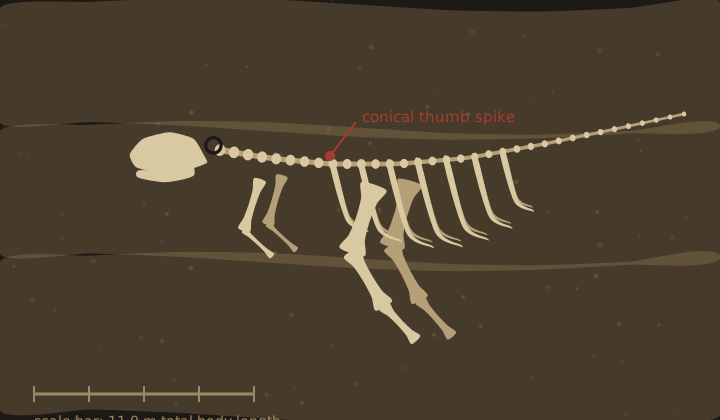
The hand has three main fingers bound together by a block of fused wrist bones that can be used to bear weight, plus the separate conical spike on the thumb. The three weight-bearing fingers are what allow a quadrupedal stance. This combination -- a load-bearing hand and a separate spike -- is unique among dinosaurs.
Posture: a century of correction
The Bernissart mounts of the 1880s showed Iguanodon in a kangaroo-like tripod. The error was structural: the ossified tendons that stiffen the tail were bent to make the pose work, and the arms were placed forward. Correcting it required recognizing that the tail is a rigid counterweight, and the modern mount at Brussels, rebuilt in the 1980s, places the animal horizontally with a high tail and the head lowered.
Sources
Reference works and further reading for the material in this entry.
Where the argument is
What the conical thumb spike was for. Mantell initially put it on the nose as a horn, and it has since been reinterpreted as a thumb, a weapon, a fruit-cracking tool and a digging implement. The current reading is that it was a thumb and could be used defensively, but the alternatives have not been formally excluded.
Frequently misread
-
ClaimIguanodon was a slow, tail-dragging quadruped.
What the record showsThe 1878 Bernissart specimens were mounted as tail-dragging quadrupeds and it took a century to correct. The spine is straight, the tail is stiffened by ossified tendons, and the animal was bipedal when moving quickly. The Bernissart mine produced at least 38 individuals.
-
ClaimThe spike is a horn, as Mantell first thought.
What the record showsMantell himself corrected this within a few years, after better material showed the conical bone sits at the end of the thumb alongside the other fingers. The Isle of Wight specimen he used for the correction is one of the more instructive mistakes in the history of the field.