Cretaceous 145 to 66.0 Ma
Tyrannosaurus
暴龙属
The last and largest of the tyrannosaurids, and the only one that lived at the very end of the Cretaceous. Roughly 12 metres long, five to nine tonnes, with a skull over 1.5 metres and teeth that could reach 30 cm including the root.
Published Reading time 2 min read
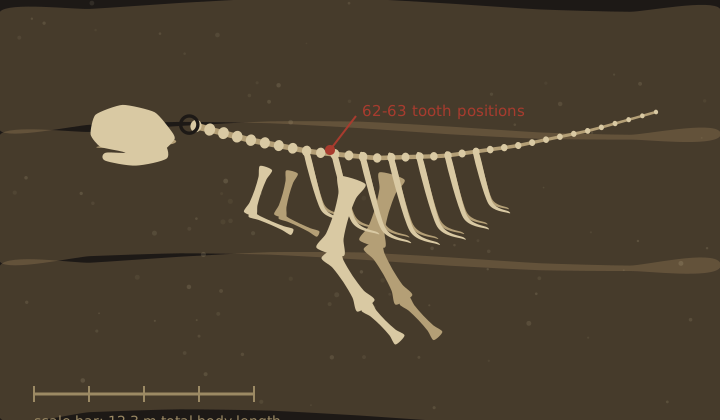
What the skeleton actually shows
The skull is built for resisting load rather than for speed of closing: the bones of the snout are fused into a rigid box, and the jaw joint sits far back, which concentrates force near the front teeth. Tyrannosaurus also has a bony palate that braces the upper jaw against bending, a feature absent in earlier tyrannosaurids.
Growth, lifespan and the price of being big
Histological work on limb bones shows the animal grew fastest between about 14 and 18 years of age, adding roughly 1,800 kg per year at peak, then slowed. The oldest individuals in the sample died in their late twenties.
- Young animals were slender, long-legged and fast; adults were heavy and deep-bodied.
- Growth rings suggest sexual maturity around 14-15 years.
- Several specimens carry healed injuries from other Tyrannosaurus, including tooth marks on the skull.
Where it sits in the food web
Hell Creek was a coastal plain with rivers draining into the shallow Interior Seaway. The known large animals are Tyrannosaurus, the ceratopsian Triceratops and the hadrosaur Edmontosaurus, and Triceratops remains are the most common large herbivore fossils there. Bone-bed accumulations with shed tyrannosaur teeth alongside hadrosaur carcasses are the standard evidence cited for active predation.
Why the arms are the way they are
Two fingers, a short humerus and a very robust forearm. Comparative work on the shoulder suggests the arm was strong in a pulling, close-range action. Whether it had a function in predation, in holding a mate, or in rising from the ground is unresolved, but the mechanical capacity is not in doubt.
The specimens that matter
The type specimen, AMNH 973, was described by Osborn in 1905. Sue (FMNH PR 2081) is the most complete at about 90 percent of the skeleton and 12.3 metres. Stan (BHI 3033) is the best-known reference for the skull and sold at auction in 2020, which makes access for researchers a live problem.
| Specimen | Nickname | Completeness | Notes |
|---|---|---|---|
| AMNH 973 | type | partial | described 1905 by Osborn |
| FMNH PR 2081 | Sue | ~90% | 12.3 m; several healed injuries |
| BHI 3033 | Stan | ~65% | skull reference; sold 2020 |
The three specimens most often cited in comparative work.
Sources
Reference works and further reading for the material in this entry.
Where the argument is
Whether the three Hell Creek tyrannosaur specimens sometimes called Nanotyrannus are a separate genus or juvenile Tyrannosaurus is still argued. A 2020 study of growth rings in two disputed skulls concluded they were growing animals, not a dwarf species, but the specimens remain the most contentious bones in North American palaeontology.
Frequently misread
-
ClaimTyrannosaurus stood upright like a kangaroo with its tail on the ground.
What the record showsThe spine is horizontal, with the tail held off the ground as a counterweight. The upright pose came from a 1915 mount that omitted the tail's balancing role and was corrected in museums from the 1970s onward.
-
ClaimIt could not run and was therefore only a scavenger.
What the record showsTop speed is disputed -- some models cap it near 20 km/h -- but that says nothing about feeding strategy. Gut contents, healed bite marks on prey species and a hadrosaur tail with a healed tyrannosaur bite all point to active predation alongside scavenging.
-
ClaimIts arms were useless vestiges.
What the record showsEach arm could press around 200 kg in a bench-press motion and the two-fingered hand bore a 10 cm claw. The arms are short relative to the body, not weak.