Jurassic 201 to 145 Ma
Archaeopteryx
始祖鸟属
Eleven specimens from a single lagoon system in Bavaria, and the fossil that made the dinosaur-bird link impossible to ignore. Crow-sized, feathered, toothed and clawed, from a time when the Solnhofen lagoons were islands in a warm sea.
Published Reading time 1 min read
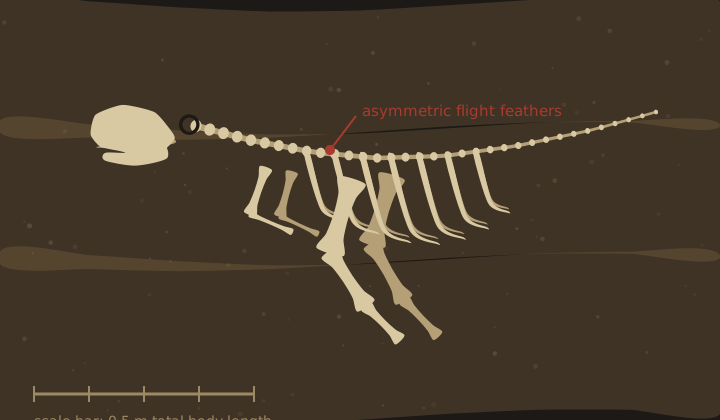
Why Solnhofen preserved feathers
The Solnhofen Limestone is a plattenkalk: fine-grained limestone deposited in lagoons that were hypersaline and anoxic at depth. Carcasses falling into them were not scavenged by bottom dwellers, and the lime mud recorded soft tissue in fine detail. That is why Archaeopteryx is known from feathers and not just bones, and why the same beds also yield jellyfish and dragonfly wings.
The mix of features, listed
The skeleton is a dinosaur's, the forelimbs are a bird's. Both sets are fully formed, which is the point.
- Dinosaur: teeth, a long bony tail, three clawed fingers, abdominal ribs, no keeled sternum.
- Bird: furcula (wishbone), asymmetrical flight feathers, a partly reversed first toe, wings that fold.
- Ambiguous: the shoulder joint permits an upstroke but the muscle attachment area is small.
Flight or glide, and what the feathers say
Individual wing feathers are shorter and more rounded than those of a modern soaring bird and longer than a typical ground bird's. The leading vane is narrower than the trailing vane, which is the geometry that resists twisting during a downstroke. That asymmetry is the strongest single argument for active flapping.
The specimens and what each added
The London specimen (1861) was the first and named on a single feather found a year earlier. The Berlin specimen (1880) is the most complete and preserves the furcula. The Thermopolis specimen (2005) preserved the foot in a way that confirmed the reversed hallux.
| Specimen | Year | What it settled |
|---|---|---|
| Isolated feather | 1860 | named before any skeleton was known |
| London | 1861 | first skeleton; teeth and long tail |
| Berlin | 1880 | most complete; furcula confirmed |
| Thermopolis | 2005 | perching-style reversed first toe |
The Solnhofen specimens in the order they changed the argument.
Sources
Reference works and further reading for the material in this entry.
Where the argument is
Whether it could fly under its own power. The furcula is present, the wing feathers are asymmetrical, and the shoulder joint allows an upstroke -- all consistent with powered flight. The counter-argument is that the sternum is not keeled enough to anchor large flight muscles, so some workers prefer a flap-assisted glide.
Frequently misread
-
ClaimArchaeopteryx is the first bird and the ancestor of all birds.
What the record showsIt is a maniraptoran dinosaur close to the origin of birds, but it is not ancestral to modern birds and lived after the bird line had already split. Its mix of features is a snapshot of a transition, not its starting point.
-
ClaimIt is a fake, or a bird with dinosaur parts glued on.
What the record showsThe claim has been raised repeatedly since 1985 and tested repeatedly. The Berlin specimen was CT-scanned in 2009 and the feather impressions, the skeleton and the matrix were shown to be a single continuous slab. No fabrication has survived examination.