Jurassic 201 to 145 Ma
Stegosaurus
剑龙属
The largest stegosaur and the one that defines the group: a small head, a humped back carrying two rows of upright plates, and four spikes at the end of the tail. From the Morrison Formation of the western United States.
Published Reading time 1 min read
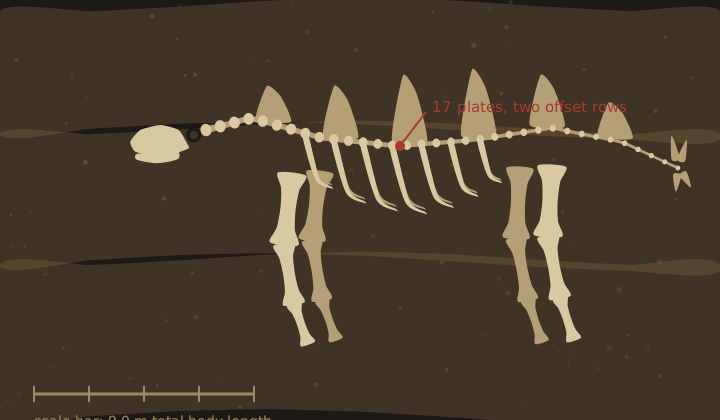
The plates, counted properly
The most complete specimen, the 1992 mount at the Denver Museum of Nature and Science, preserves 17 plates and the tail spikes in place. Plate size follows a curve: small at the neck, largest over the hips, then shrinking toward the tail, where they give way to the spikes.
A head that cannot chew
The skull is small relative to the body and the beak has no teeth. The cheek teeth are small, leaf-shaped and arranged in a single row with no dental battery, so food was cropped and swallowed with little processing. Gastroliths have been reported with stegosaur material but never in a convincing enough association to prove they were used as grinding stones.
Growth and posture
The hind limbs are long, the forelimbs short, which gives a sloping back with the highest point over the hips. Trackways attributed to stegosaurs show a quadrupedal gait with a relatively narrow track and no evidence of dragging the tail.
- Hindlimb ~2x forelimb length.
- Hip height roughly 3.5 m in the largest individuals.
- Tail carried clear of the ground.
What the injuries say about its life
Several Morrison specimens preserve pathologies: a broken and healed tail spike, fused vertebrae, and a tail vertebra from a different individual with a puncture whose spacing matches a stegosaur spike. That last specimen is the strongest single piece of evidence that the spikes were weapons rather than display.
Sources
Reference works and further reading for the material in this entry.
Where the argument is
What the plates were for. Display is the leading explanation, supported by the fact that no two individuals have the same plate arrangement and that the plates sit along the highest point of the back where they would be visible in profile. Thermoregulation has been proposed repeatedly but the blood-vessel traces that would support it have not held up under re-examination.
Frequently misread
-
ClaimThe plates lay flat on the back like roof tiles.
What the record showsThey stood upright, in two alternating rows offset from the midline. The flat-lying reconstruction came from an 1880s mount made before the plates were properly associated with the skeleton.
-
ClaimIt had a second brain in its hip, which is why it was stupid.
What the record showsThe enlarged space in the sacrum held the glycogen body, a structure present in living birds, and a nerve bundle serving the hind limbs. It is not a brain and the animal's intelligence cannot be read from it either way.
-
ClaimThe tail spikes were defensive and pointed straight up.
What the record showsThey were horizontal or angled, mounted on the sides of the tail, and could swing laterally. A puncture in an Allosaurus tail vertebra matches a stegosaur spike, which supports the defensive reading for the spikes while leaving the plates unexplained.