Jurassic 201 to 145 Ma
Brachiosaurus
腕龙属
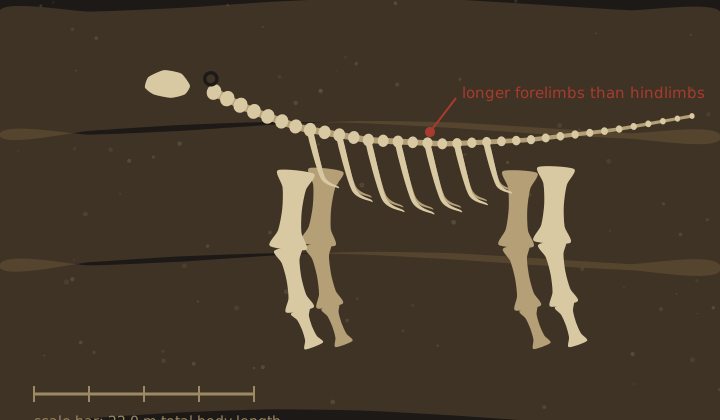
A Morrison sauropod that breaks the family pattern: the forelimbs are longer than the hindlimbs, so the shoulders ride higher than the hips and the neck leaves the body almost vertically. The reach was high, whatever the posture.
Published Reading time 2 min read
The proportions that define it
In most sauropods the hips are the high point. In Brachiosaurus the humerus is longer than the femur, which tilts the whole trunk back and puts the shoulder at the top of the animal. The neck then rises from a shoulder that is already elevated, which is why the genus reaches higher than longer-necked contemporaries.
- Humerus longer than femur.
- 14 cervical vertebrae, each with elongated centra.
- Nares set high on the skull, above the level of the eye.
The nostrils, and a hundred years of argument
Brachiosaurus has its bony nostrils high on the top of the skull, which for most of the twentieth century was read as evidence of a snorkel and an aquatic life. The current reading is that the bony opening is not where the fleshy nostril sat; in sauropods the nasal opening is retracted and the soft tissue nostril would have been further forward. The high bony nares are a sauropod feature, not a diving adaptation.
Feeding height, calculated
With the shoulder at about 6 m and the neck fully raised, the head could reach roughly 9 m above the ground, and the animal could have browsed conifers at that level. The cost is circulatory: a head 9 m up demands a mean arterial pressure far above anything measured in a living animal, and the standard resolution is that the neck was habitually carried lower, sweeping through a wide lateral arc.
| Posture | Head height | Cost |
|---|---|---|
| neck low, sweeping | ~4.5 m | normal reptilian blood pressure |
| neck at 45 degrees | ~7 m | elevated pressure, brief |
| neck vertical | ~9 m | near the limit of a four-chambered heart |
What the neck costs at each angle -- the reason most workers prefer the low sweep.
The specimen history, briefly
Riggs named Brachiosaurus altithorax in 1903 from a partial skeleton in western Colorado. A second partial skeleton from the same quarry was collected in 1909 and formed the core of the mount in Chicago, which was completed in 2000. The Tanzanian material that had been called Brachiosaurus was separated as Giraffatitan in 2009, which also removed the largest mass estimates from the genus.
Sources
Reference works and further reading for the material in this entry.
Where the argument is
How high it could actually hold its head. The neck has 14 vertebrae and the shoulder is high, so the reach is considerable; but raising the head to full height would have demanded a heart pressure near the limit of what a four-chambered heart can do. Most current work favours a habitual posture with the neck held well below maximum, swinging laterally rather than stretched vertically.
Frequently misread
-
ClaimBrachiosaurus lived in water because it could not support its own weight.
What the record showsThe limbs are columnar with a straight, weight-bearing shaft, and the fossil beds are floodplain soils, not lake bottoms. Riggs, who described the genus, argued against the aquatic hypothesis in 1904 on exactly this evidence.
-
ClaimThe animal mounted in Berlin is Brachiosaurus.
What the record showsThe Berlin skeleton is Giraffatitan brancai, from Tendaguru in Tanzania, and it was moved into its own genus in 2009. The only well-known Brachiosaurus skeleton is the one in Chicago, built partly from the type specimen.