Jurassic 201 to 145 Ma
Diplodocus
梁龙属
One of the longest dinosaurs known, and the one whose skeleton has been reproduced more times than any other: Andrew Carnegie sent plaster casts to museums across Europe and Latin America in the early 1900s, which is why so many institutions have a Diplodocus in the hall.
Published Reading time 2 min read
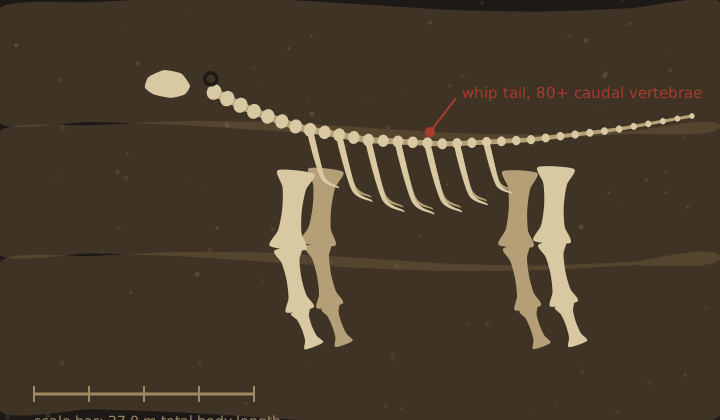
Built like a beam with whips at both ends
The skull is small and sits at the end of a long, low neck, and the tail continues for over eighty vertebrae. The limb bones are relatively slender for the animal's length, and the ribcage is narrow. Diplodocus is not simply Brachiosaurus stretched out; the two genera partition the trees at different heights.
- Neck: 15 cervical vertebrae, held near horizontal.
- Tail: over 80 caudal vertebrae, with a whip-like end.
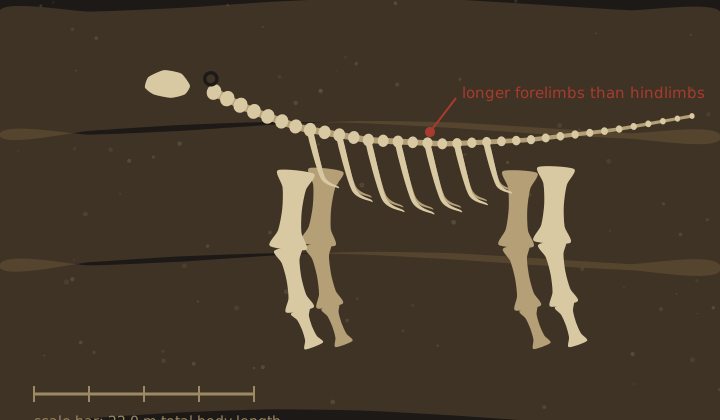
- Forelimbs: shorter than the hindlimbs, unlike Brachiosaurus.
A skull that suggests something peculiar about feeding
The teeth sit only at the front of the jaws, are pencil-shaped and are worn in a way that suggests they raked through foliage rather than biting it off. One proposal has Diplodocus stripping leaves from branches by pulling its head back through them; another has it cropping low vegetation. Both are consistent with the narrow snout and the absence of a broad cropping beak.
The casts that made it famous
Andrew Carnegie financed the excavation of the specimen now catalogued as CM 84, and in 1907 had casts made and shipped to museums in London, Berlin, Paris, Vienna, Bologna, St Petersburg, Buenos Aires and Mexico City, among others. The Carnegie cast is the reason Diplodocus became the most widely displayed dinosaur in the world.
| Specimen | Held | Note |
|---|---|---|
| CM 84 | Carnegie Museum | the animal the casts were taken from |
| USNM 10865 | Smithsonian | the mount that put the neck lower |
| D. carnegii type | Carnegie Museum | named for Carnegie in 1901 |
The specimens behind the most widely distributed dinosaur skeleton in the world.
Growth and the small skull
Juvenile diplodocids have proportionally shorter necks and larger heads than adults, and the skull is small even at full size -- a reminder that sauropod growth changed the proportions substantially. Histology on related genera indicates they reached adult size over roughly two to three decades.
Sources
Reference works and further reading for the material in this entry.
Where the argument is
Whether the tail could crack like a whip. A 1997 model argued that the distal tail could reach supersonic tip speeds and produce a crack loud enough to serve as a warning, but the model assumed a stiffness and a muscle arrangement that later work questioned. The tail was certainly mobile and certainly swung; whether it was a bullwhip is unresolved.
Frequently misread
-
ClaimDiplodocus held its neck up to reach high foliage.
What the record showsThe cervical vertebrae are constructed so the neck is most easily held near horizontal, and the forelimbs are shorter than the hindlimbs, which tilts the shoulders down. The reach is forward, not up.
-
ClaimThe tail dragged on the ground behind it.
What the record showsThe tail is long, light and muscular, and it counterbalances the neck. Trackways of diplodocids show no tail drag marks, and the tail base is built for a high carry.