Cretaceous 145 to 66.0 Ma
Mosasaurus
沧龙属
The largest mosasaur, and the animal that gave the Maastricht quarries their fame: a marine lizard up to 17 metres, with a jaw that hinged open at the back and a second row of teeth on the roof of its mouth.
Published Reading time 2 min read
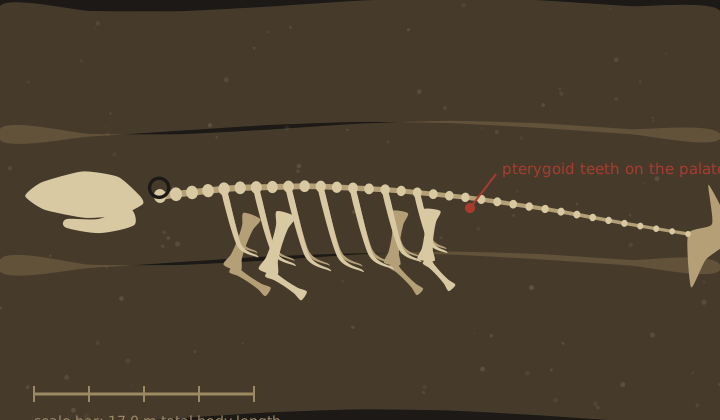
How it swam, after the 2013 tail
Mosasaurus has a laterally flattened body, paddle-like limbs that could not support it on land, and a tail whose vertebrae bend downward at the tip. That downward bend carries the lower lobe of a fluke, so the animal swam by beating its tail side to side, with the paddles used for steering. Earlier restorations that gave it a straight, eel-like tail and a serpentine swim were wrong about the profile and the gait.
- Propulsion: tail, side to side.
- Steering: four paddles.
- The paddles could not lift the body onto land.
Two rows of teeth
Besides the marginal teeth on the jaw, mosasaurs carry a second row on the pterygoid bones of the palate. The jaws are loosely joined at the front and the quadrate allows the lower jaw to swing forward and back, so prey was gripped and then worked backwards by the palatal teeth, which is how a snake feeds.
- Marginal teeth: grasping, strongly recurved, faceted.
- Pterygoid teeth: ratcheting the prey backwards.
- Jaw joint: mobile, allowing a wide gape.
What it ate, from stomach contents
Mosasaur gut contents have been reported containing fish scales and bones, remains of the sea turtle Allopleuron, ammonite shells, and pieces of smaller mosasaurs. A specimen from the Netherlands produced a small mosasaur's skull inside the ribcage. The animal was clearly not a specialist.
The Maastricht skull and its journey
The type skull was found in the Sint-Pietersberg quarries near Maastricht around 1770 and became a prize in the French Revolutionary wars: it was removed to Paris in 1794 and is still in the Muséum national d'Histoire naturelle. It was described by Conybeare in 1822, and the Maastricht Formation takes its name from the same town.
| Year | Event |
|---|---|
| c. 1770 | skull found in the Sint-Pietersberg quarries |
| 1794 | removed to Paris by the French army |
| 1822 | named Mosasaurus by Conybeare |
| 1829 | the genus lends its name to the Maastrichtian stage |
The type specimen's biography, which is also the reason the Maastrichtian is called that.
Sources
Reference works and further reading for the material in this entry.
Where the argument is
Whether Mosasaurus had a bilobed tail fluke. A 2013 description of a well-preserved mosasaur tail from Jordan showed the vertebral column bending downward into the lower lobe, the same arrangement seen in sharks and ichthyosaurs. That settled the tail's shape, but the exact soft-tissue outline of the upper lobe is still inferred rather than preserved.
Frequently misread
-
ClaimMosasaurus is a dinosaur.
What the record showsIt is a squamate -- a lizard -- in the same order as monitors and snakes, and it lived alongside the dinosaurs rather than among them. Its closest living relatives are monitor lizards and the Komodo dragon.
-
ClaimIt swam by undulating like a snake or an eel.
What the record showsUnlike a snake, a mosasaur's body is stiffened by a deep ribcage and its tail carries a fluke, so the swimming stroke is confined to the rear third of the body. A snake's undulation runs the whole length; a mosasaur's does not.