Cretaceous 145 to 66.0 Ma
Pteranodon
无齿翼龙属
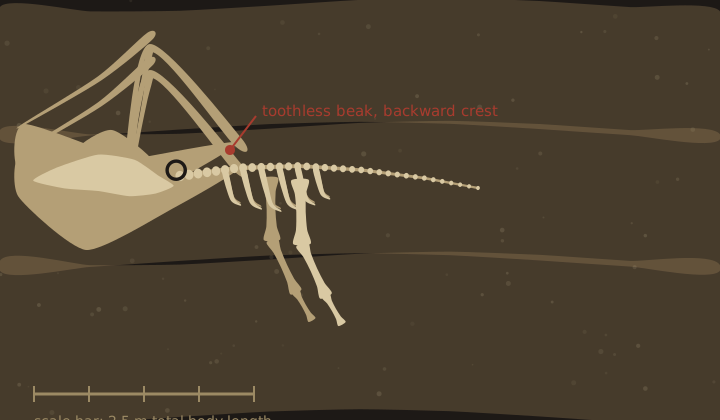
A fish-eating pterosaur from the Western Interior Seaway, known from over a thousand specimens, which makes it the best-sampled pterosaur in the world. Wingspan up to 7.25 metres, and a head crest that is the clearest case of sexual dimorphism in any Mesozoic reptile.
Published Reading time 2 min read
A thousand specimens from one sea
The Niobrara Chalk was deposited in the Western Interior Seaway, a shallow sea that split North America from the Gulf of Mexico to the Arctic in the Late Cretaceous. Pteranodon carcasses that sank into its anoxic bottom sediments were preserved in quantity, and nineteenth-century collectors working for Marsh and Cope recovered hundreds. That sample size is why Pteranodon is where most of pterosaur biology was worked out.
The crest, and the two forms
Adult Pteranodon skulls come in two shapes: large, broad crests sweeping backward and upward, always with a wider skull and larger body size, and smaller, narrower, more vertical crests. The two forms are found in the same strata and the same quarries. Every specimen with a small crest is smaller overall, which the standard interpretation reads as female.
- Broad crest: larger skull, larger pelvis, wider wing bones.
- Narrow crest: smaller overall, narrower pelvis.
- Juveniles of both: small crests that grow during ontogeny.
Flight, calculated
Pteranodon's wing bones are hollow and the walls are thin, and the animal's mass is estimated around 20-25 kg against a 7-metre wingspan. Modelling of pterosaur flight puts Pteranodon in a soaring regime: high aspect ratio, low wing loading, exploiting shear over the seaway. Takeoff from the water using the forelimbs, as a modern albatross does, is the model that best fits the limb proportions.
Where the fish remains come from
Several specimens preserve the contents of the throat pouch and stomach, and they contain fish. Some Pteranodon specimens also contain the remains of the toothed pterosaur Nyctosaurus and of the bird Ichthyornis, which suggests the animal did not always feed politely.
| Feature | Pteranodon | A bird with the same wingspan |
|---|---|---|
| Wing | membrane on one finger | feathers on fused arm bones |
| Beak | toothless, with a pouch | toothless or toothed, no pouch |
| Ground gait | quadrupedal on wing knuckles | bipedal on hind limbs |
| Wing bones | thin-walled, hollow, no marrow | hollow, strutted internally |
Why a pterosaur wing is not a bird wing, even at the same scale.
Sources
Reference works and further reading for the material in this entry.
Where the argument is
How much of the crest's size is species difference and how much is sex. Large, broad, backward-swept crests and small, narrow, upward crests occur together in the same beds, and the standard reading is that the two forms are male and female. Sceptics point out that some of the separation may be age, and that the sexes of a single pterosaur species have never been confirmed from a specimen with preserved eggs.
Frequently misread
-
ClaimPteranodon is a dinosaur, or a bird.
What the record showsIt is a pterosaur, an archosaur on its own branch, and its wing is a membrane supported by a single enormously elongated fourth finger -- not a feathered arm. Birds and pterosaurs both fly, but they did not inherit flight from the same ancestor.
-
ClaimIt could pick up prey with its feet, like an eagle.
What the record showsThe hind limbs are small and the feet are weak. The standard feeding model is a low pass over the water with the beak dipped in, the lower jaw skimming, which matches the long, slender, toothless jaws and the preserved fish remains.