Cretaceous 145 to 66.0 Ma
Spinosaurus
棘龙属
The longest known theropod, and the one whose reconstruction has changed more than any other large dinosaur in the last two decades. Built around a long, narrow, crocodile-like snout and a sail of tall back spines.
Published Reading time 2 min read
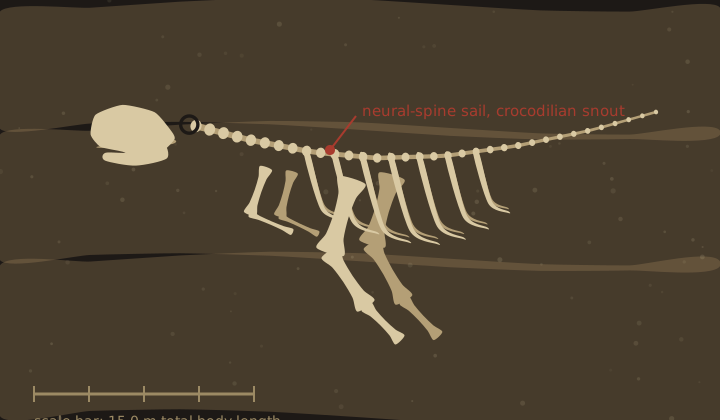
A skull for catching fish
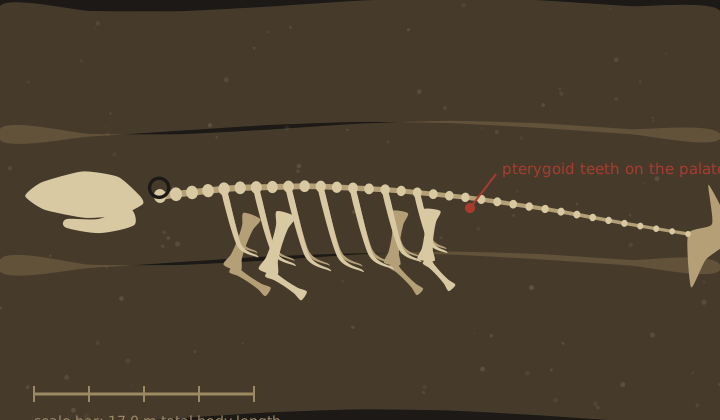
The snout is long, low and narrow, and the teeth are conical and slightly recurved rather than blade-like, with a dense pattern of small pits and a partly interlocking arrangement at the front. That is the same set of features seen in crocodilians that eat fish and in the related Baryonyx, whose gut contents included fish scales. Spinosaurus also has a small terminal rosette of teeth at the very front of the jaw.
- Conical, unserrated teeth -- for gripping, not slicing.
- Long secondary palate -- resists twisting when prey struggles.
- Naris retracted far back on the snout.
The sail, and what it is not
The sail is made of neural spines up to 1.6 m long, taller than the spines of Dimetrodon relative to body size, and they are joined by a ridge along the back. Unlike Dimetrodon's, Spinosaurus's spines have a straight, rod-like profile. The function is unresolved; display is the most common reading, and the sail would also have made the animal look considerably larger from the side.
The 2014 reconstruction and the argument it started
New Moroccan material published in 2014 combined with Stromer's lost specimens to produce a reconstruction with very short hind limbs, a long torso and a deep tail. That reconstruction was mounted as a quadruped. The argument since has been about limb proportions and about whether the animal's centre of mass would allow it to walk on four legs; a 2022 study of the tail found it generated eight times the thrust of a comparable theropod tail, which supports swimming but not necessarily exclusive aquatic life.
| Evidence | Points to | Counter-reading |
|---|---|---|
| high bone density | semiaquatic | within the range of wading animals |
| short hind limbs | quadrupedal wading | disputed by later assessment |
| deep, flexible tail | capable swimmer | many terrestrial animals can swim |
| fish-dominated teeth and jaw | piscivory | also true of wading birds |
What each line of evidence supports, and what the counter-argument is.
Where it lived
The Bahariya and Kem Kem beds were river and delta systems on the northern margin of Gondwana, with an enormous fish fauna including the giant coelacanth Mawsonia and the sawfish Onchopristis, whose rostral teeth are found in the same beds. Spinosaurus shared those waters with the crocodylomorphs and with the large theropod Carcharodontosaurus.
Sources
Reference works and further reading for the material in this entry.
Where the argument is
How aquatic it was. Bone density in Spinosaurus is high and its hind limbs are short, which the 2014 and 2020 papers read as semiaquatic adaptation; a 2022 study of bone compactness across spinosaurids found the density was not outside the range of animals that wade, and a 2022 tail study found the tail was a capable swimming organ. The current position is that Spinosaurus spent a great deal of time in water and could swim, but was not a fully marine pursuit predator of the kind an ichthyosaur was.
Frequently misread
-
ClaimSpinosaurus was bigger than Tyrannosaurus, so it would win a fight.
What the record showsThe two are close in length but Spinosaurus is much lighter for its length, and the two lived on different continents about 30 million years apart. Size alone does not decide an encounter, and in any case the encounter never happened.
-
ClaimThe type specimen still exists.
What the record showsThe original Egyptian material, described by Stromer in 1915, was destroyed in a British bombing raid on Munich in April 1944. Everything known about Spinosaurus since then rests on Stromer's drawings and photographs until the Moroccan and Algerian material of the 1990s onward.