Jurassic 201 to 145 Ma
Ichthyosaurus
鱼龙属
A dolphin-shaped marine reptile from the Lower Jurassic, and one of the first fossil animals to be recognized as extinct. Its body outline is known from specimens so well preserved that the soft-tissue fin and the contents of the abdomen can be read directly.
Published Reading time 2 min read
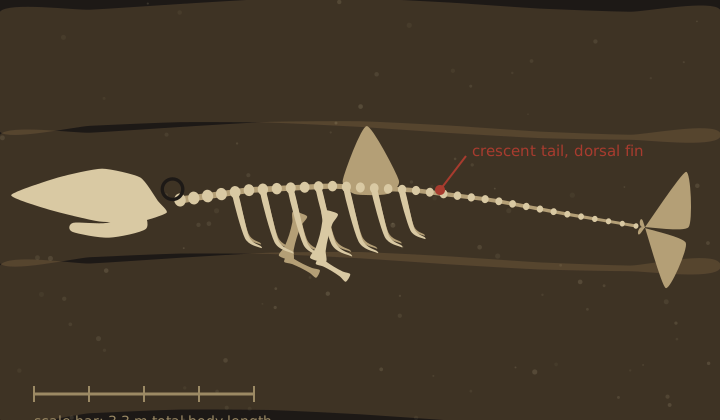
A body that says 'fast' before anything else
Ichthyosaurus has a streamlined trunk, a very short neck, a large head with a long toothy snout, and four flippers that are much smaller than the tail. The tail bends downward at its end to support a large lower lobe, and there is a dorsal fin. The whole configuration is the same one that appears in dolphins and tuna: a stiff body, a high-aspect-ratio tail, small control surfaces.
- Trunk depth greater than width -- laterally compressed.
- Neck of fewer than 10 vertebrae.
- Flippers: four, all small, all used for steering.
The Holzmaden evidence
The Posidonia Shale at Holzmaden in southern Germany preserves ichthyosaurs in fine detail, including body outlines with the dorsal fin and the unlobed upper part of the tail fin, and intestinal contents. Pregnant females are common there, and one locality has yielded specimens with the embryos still inside. Some Holzmaden slabs show the animals clearly, some show only a dark smear; the difference is which layer of the sediment they landed in.
Eyes and feeding
The eye is enormous relative to the skull and is protected by a ring of bony plates -- a sclerotic ring -- which is common in animals that dive and in animals that hunt in low light. The teeth are conical and set in a long groove, and the coprolites associated with Ichthyosaurus contain belemnite hooks and fish scales.
| Feature | Ichthyosaur | Dolphin |
|---|---|---|
| Tail | vertical, fish-like, beats side to side | horizontal, beats up and down |
| Spine | moves side to side | moves up and down |
| Offspring | live birth (fossils show it) | live birth |
| Flippers | four | two |
Convergence is not identity: the same shape, driven a different way.
The birth of the study of extinction
Ichthyosaurus was described in 1814 from a specimen collected at Lyme Regis, and the anatomist Everard Home worked on it soon after. Because a reptile with a fish-like tail and flippers matched nothing alive, the material forced the recognition that some animals had existed and ceased to exist -- an argument that Cuvier was making at the same time in Paris from his own material.
Sources
Reference works and further reading for the material in this entry.
Where the argument is
How deep the tail bend was and what it means. The vertebral column bends sharply down into the lower lobe of the tail fin, and the bend's degree has been used to separate species. A 2016 review argued that the bend is strongly affected by how the tail was preserved -- it can be exaggerated during compaction -- so the character is less reliable than it was treated as being.
Frequently misread
-
ClaimThe flippers were the main means of propulsion.
What the record showsThe tail is the propeller. Ichthyosaurus has an enormous tail fin whose upper lobe is made only of soft tissue with no bone inside, and a dorsal fin of the same kind. Both are known from outlines preserved in the Holzmaden shales.
-
ClaimIchthyosaurs were dinosaurs that returned to the sea.
What the record showsIchthyosaurs are not dinosaurs and not even close: they branch off the diapsid stem before the archosaur line that produced dinosaurs and crocodiles. They appeared before the first dinosaurs and died out before the dinosaurs did.