Jurassic 201 to 145 Ma
Plesiosaurus
蛇颈龙属
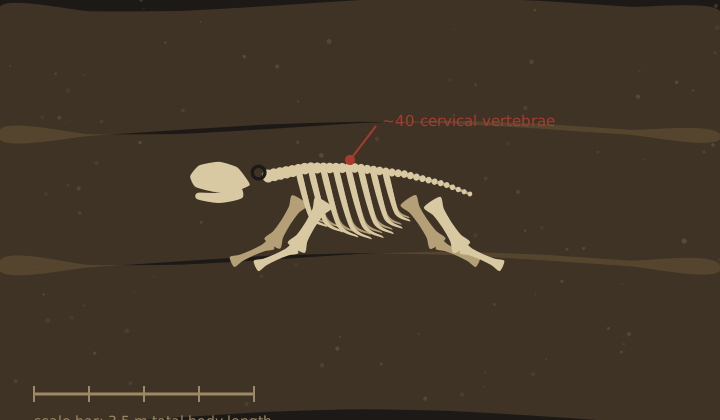
A long-necked marine reptile from the Lower Jurassic of Dorset, named from one of Mary Anning's finds. It is the animal that gave the plesiosaurs their name and their popular image, and it is also the one whose neck posture has been most consistently misdrawn.
Published Reading time 2 min read
Two body plans, one name
Plesiosauria contains two very different shapes: the long-necked plesiosauroids, of which Plesiosaurus is the exemplar, and the short-necked pliosauroids, which have a large head and a short, thick neck. Both have four large flippers, a short tail and a stiff, broad trunk. The split appears to be a feeding adaptation -- the long neck for reaching into schools of small prey and the short neck for seizing large prey.
- Plesiosauroid: small head, neck up to 76 vertebrae in the most extreme relatives.
- Pliosauroid: head up to 3 m in the largest, neck of 13 or fewer vertebrae.
- Both: four flippers, no tail propulsion.
How the flippers moved
The flipper skeleton is not a wing that twists; the bones are stiff, and the shoulder and hip joints have limited rotation. That points to underwater flight, in which each flipper works like a rigid hydrofoil on a flapping stroke rather than a rowboat's oar. Studies using fossil trackways and flipper joints favour a sequence in which the four flippers move one after another with a small lag.
| Gait | Prediction | Status |
|---|---|---|
| All four together | strong pitch, wasteful | not supported by joint anatomy |
| Front pair leads, rear follows | thrust from both, low drag | best fit in simulation |
| Front only | rear flippers dead weight | contradicted by their robust bones |
Three possible four-flipper gaits and what the anatomy says about each.
What the gut contents show
Mary Anning's specimens, and later ones from the same beds, have produced gut contents of fish scales, belemnite hooks and pterosaur bones. The belemnite hooks are the hard parts of the arms of a squid-like animal, and their presence in the stomach region confirms a diet of soft cephalopods alongside fish.
Mary Anning's contribution
Anning collected the near-complete specimen that Conybeare used to name the genus, and it was sold to the British Museum. She was working as a commercial collector on a coast where the Lower Lias erodes out of the cliffs fastest in winter, and several of the taxa that founded British palaeontology came out of her hands without her name on the paper.
Sources
Reference works and further reading for the material in this entry.
Where the argument is
How the four flippers were used together. Filmed swimming in living sea turtles and penguins suggests a gait in which the foreflippers lead and the hind pair follows a fraction of a second later. Computer simulation of a plesiosaur with a four-flipper sequence produced the most efficient results, but no one has observed the animal, so the gait remains a model rather than a reconstruction.
Frequently misread
-
ClaimIt held its neck out of the water like a swan.
What the record showsThe neck has around 40 vertebrae and cannot bend much at any single joint, so the swan curve is not achievable. If the neck was held above water, the animal's centre of mass would put the flippers too deep to swim. The head was more plausibly held level with the body under water.
-
ClaimIt came ashore to lay eggs.
What the record showsThe flippers are rigid and cannot be used to walk, and the pectoral and pelvic girdles are flat plates with no weight-bearing joint. Like living whales and ichthyosaurs, plesiosaurs must have given birth to live young; a 2011 specimen of a related genus was found with a single large embryo inside it.